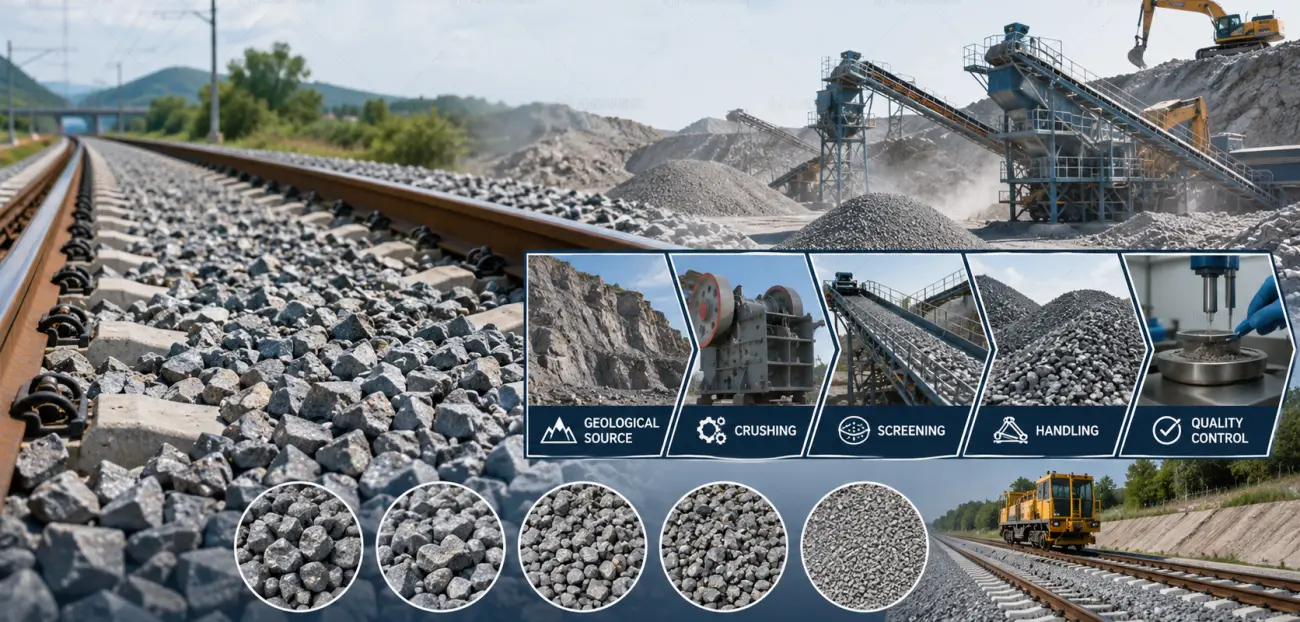
Railway ballast is not simply crushed stone placed beneath railway tracks. It is an engineering material whose physical and mechanical characteristics directly affect track stability, drainage, load distribution, and long-term performance. These requirements begin with the geological source and extend through crushing, screening, handling, and quality control. Understanding this connection is essential for producing ballast that not only meets specified requirements, but also performs reliably throughout its service life.
The Engineering Role of Railway Ballast in Track Performance
Railway ballast forms a critical part of the track structure, providing support, drainage, and resistance to movement beneath the sleepers. These functions depend on the ballast maintaining a stable particle structure under repeated train loading and changing environmental conditions.
Load Distribution and Support for Railway Tracks
Railway loads are transferred through several structural layers before reaching the substructure:
Train Load → Rail → Sleeper → Ballast → Substructure
Ballast distributes the forces transferred through the sleepers over a wider area, reducing localized stress and providing more uniform support to the track structure.
Its effectiveness depends on maintaining a stable particle arrangement. Excessive compaction, deformation, or degradation can gradually reduce the consistency of support provided by the ballast layer.
Particle Interlocking and Track Stability
Angular ballast particles interact with one another to form a mechanically stable structure. This interlocking helps resist movement caused by train loads and supports the position of the sleepers.
A well-structured ballast layer contributes to:
- Lateral stability: Helps resist sideways movement of the track and sleepers.
- Longitudinal stability: Helps limit movement along the direction of the track.
- Track geometry: Provides a stable foundation for maintaining alignment and level.
The effectiveness of this interlocking depends on the size, shape, and surface characteristics of the particles.
Drainage Through the Ballast Layer
The voids between ballast particles provide pathways for water to move through the track structure. Effective drainage helps prevent water from accumulating around the sleepers and underlying layers.
- Particle arrangement: Determines the size and connectivity of drainage spaces.
- Fines accumulation: Fine material can fill these spaces and restrict water movement.
- Particle degradation: Breakage can alter the ballast structure and generate additional fines.
Ballast must therefore provide both mechanical support and sufficient drainage capacity throughout its service life.
Long-Term Stability Under Repeated Train Loading
Railway traffic subjects ballast to repeated loading cycles that can gradually cause particle rearrangement, breakage, and settlement.
The resulting deterioration may affect:
- Ballast condition: Particle degradation can alter the structure and increase fine material.
- Track geometry: Settlement and uneven support can affect alignment and level.
- Maintenance demand: Progressive deterioration can increase the need for tamping and other maintenance activities.
Heavier axle loads, higher train speeds, and greater traffic intensity can place additional demands on ballast. Its ability to maintain a stable structure over repeated loading is therefore essential to long-term track performance.
What Defines High-Quality Railway Ballast?
There is no single property that determines whether an aggregate is suitable for railway ballast. Reliable ballast requires a balanced combination of size, shape, strength, durability, and cleanliness.
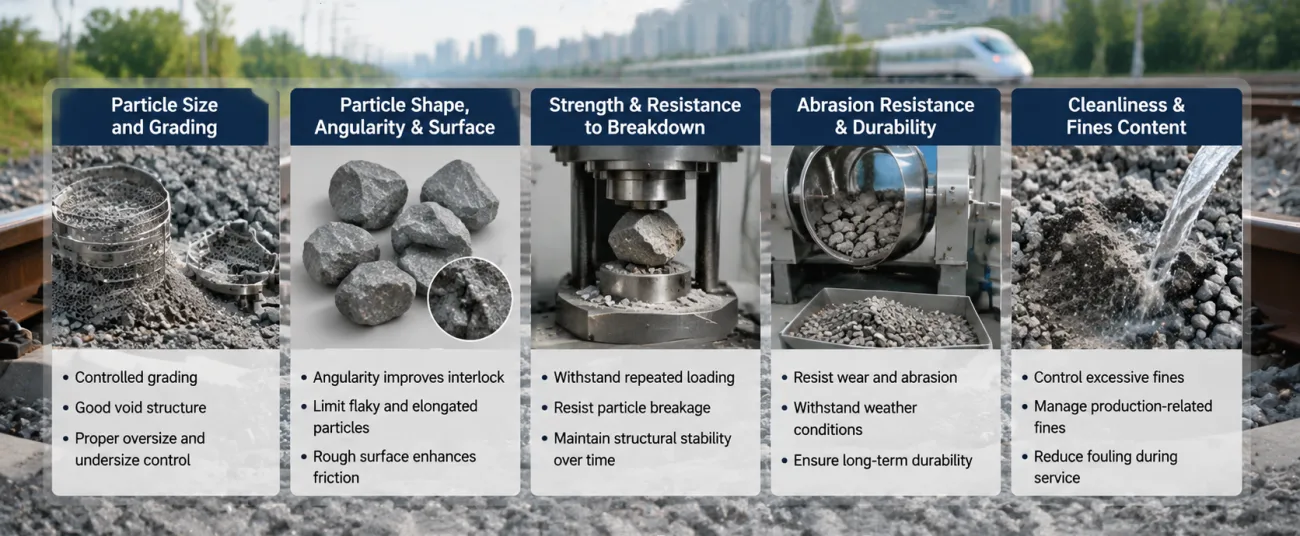
Particle Size and Grading
Particle size is important, but the overall distribution of sizes is more meaningful than nominal size alone.
- Controlled grading: A consistent particle-size distribution helps create a predictable ballast structure and stable contact between particles.
- Void structure: The arrangement of particles determines how much interconnected space remains within the ballast layer, directly affecting drainage.
- Oversize and undersize control: Excessively large or small particles can disturb the intended structure and reduce consistency.
The objective is therefore to maintain a consistent grading that supports both stability and drainage.
Particle Shape, Angularity, and Surface Characteristics
Particle shape determines how individual pieces contact and interlock within the ballast layer.
- Angularity: Angular particles generally provide stronger mechanical interaction and resistance to movement than rounded particles.
- Flakiness and elongation: Excessively flaky or elongated particles can create less stable contact arrangements.
- Surface texture: Rougher surfaces can improve friction and particle interaction, contributing to mechanical stability.
Two aggregates with similar particle sizes can therefore behave differently in railway applications because particle shape influences how the ballast structure performs.
Strength and Resistance to Particle Breakdown
Ballast must withstand repeated loading without excessive particle breakage.
- Load resistance: Strong particles can better withstand the repeated forces transferred through the sleepers.
- Breakage resistance: Excessive particle breakdown can alter grading and generate additional fine material.
- Structural stability: Maintaining particle integrity helps preserve the load-bearing structure over time.
The key concern is therefore long-term resistance to degradation rather than simply initial rock strength.
Abrasion Resistance and Durability
Ballast is exposed to continuous particle contact, movement, moisture, and environmental conditions throughout its service life.
- Abrasion resistance: Better resistance to wear helps limit the gradual production of fine particles.
- Weather resistance: The material needs to remain stable under the climatic conditions of the railway environment.
- Long-term durability: Durable ballast can retain its required physical characteristics for longer and slow structural deterioration.
Hardness alone is therefore not enough to determine suitability. The more important question is whether the material can maintain its required performance under actual loading and environmental conditions.
Cleanliness and Fines Content
Ballast cleanliness is closely related to the preservation of its internal void structure.
- Controlled fines: Excessive fine material can occupy spaces between larger particles and restrict water movement.
- Production-related fines: Crushing and screening can generate fine material that needs to be controlled during processing.
- Service-related fines: Particle breakdown, soil intrusion, and other sources can introduce additional fines after placement.
Producing clean ballast at the quarry does not guarantee that fouling will never occur during service.
From Geological Source to Ballast Suitability
The geological source determines the foundation of ballast quality. Rock properties influence crushing performance, particle shape, and long-term durability, making quarry evaluation a critical step in ballast production.
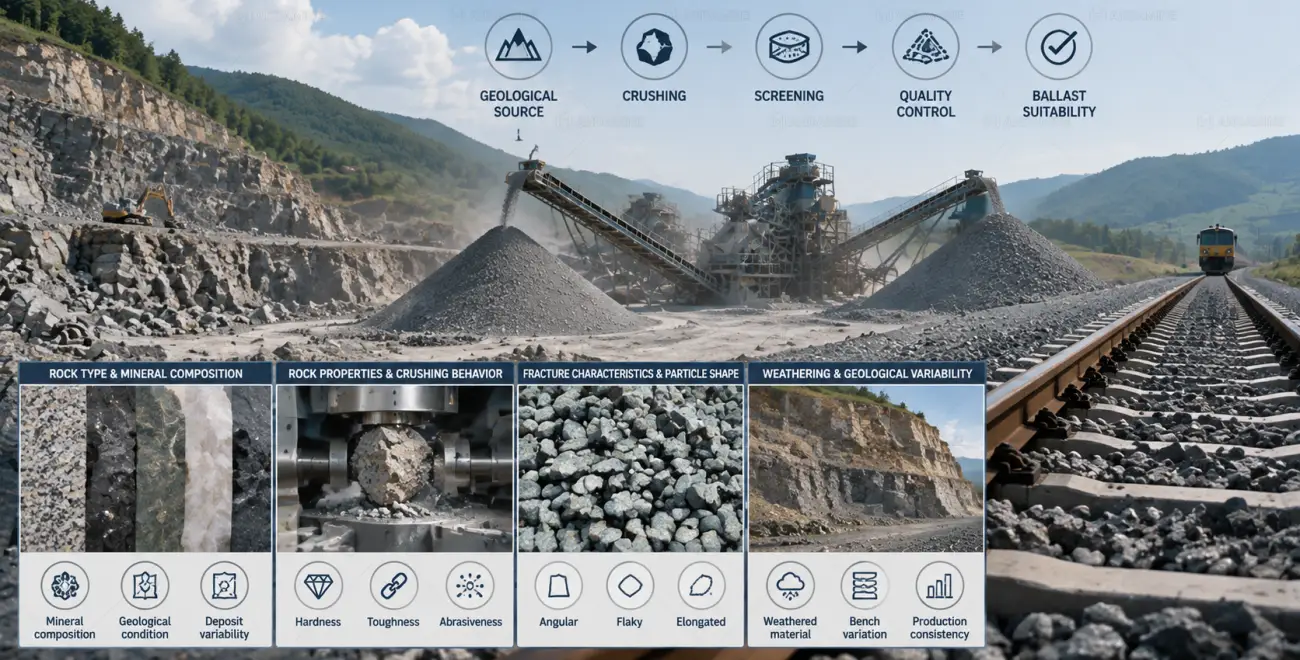
Rock Type and Mineral Composition
Granite, basalt, gabbro, quartzite, and other competent rocks are commonly considered as ballast sources. However, identifying the rock type is only the first step in evaluating a deposit.
- Mineral composition: Different minerals can respond differently to loading, abrasion, and weathering, affecting the overall behavior of the rock.
- Geological condition: Alteration, microcracks, and other internal features can make similar rock types behave differently during processing and service.
- Deposit variability: Rock characteristics may change within the same quarry, so suitability needs to be assessed across the actual production area.
The key question is whether the deposit can consistently provide material with the engineering characteristics required for ballast.
Rock Properties and Crushing Behavior
The physical characteristics of source rock influence how it responds to crushing. Hardness, toughness, abrasiveness, and internal structure can affect energy requirements, equipment wear, and the way particles fracture.
- Hardness: Harder rock generally requires greater resistance from the crushing process and can increase energy consumption and wear.
- Toughness: Tough materials may resist fracture and respond differently from more brittle rock under similar crushing conditions.
- Abrasiveness: Highly abrasive rock can increase wear during processing and affect production stability.
These differences mean that the same processing arrangement may produce different results from different geological sources, making feed characteristics an important consideration in ballast production.
Fracture Characteristics and Particle Shape
Natural geological structures strongly influence how rock breaks during extraction and crushing.
Geology → Fracture Behavior → Crushing Response → Particle Shape
- Natural fractures: Joints, bedding planes, and mineral boundaries can create preferred breakage paths within the rock.
- Particle formation: The way rock fractures can influence the proportion of angular, flaky, and elongated particles produced during crushing.
- Processing interaction: Crushing conditions can further modify particle shape, but the original rock structure remains an important influence.
Particle shape is therefore determined by both the geological characteristics of the source and the subsequent processing conditions.
Weathering and Geological Variability
Weathering and changes within the geological deposit can introduce uncertainty into ballast production. Weathered zones may contain weaker minerals, cracks, higher porosity, or altered rock that behaves differently from fresh material.
- Weathered material: Weaker zones can fracture more easily and may generate different particle characteristics or higher levels of unwanted fines.
- Bench variation: Changes in rock properties between quarry benches or extraction areas can alter feed conditions during long-term production.
- Production consistency: Monitoring geological variation helps operators anticipate changes in feed behavior and maintain more stable processing conditions.
Quarry evaluation should therefore consider both the quality and variability of the geological resource. Consistent ballast production begins with a sufficiently consistent geological resource.
How Aggregate Processing Shapes Railway Ballast Quality
The processing stage plays a key role in ballast quality. Crushing and screening must work together to achieve the required particle characteristics, grading, and production efficiency.
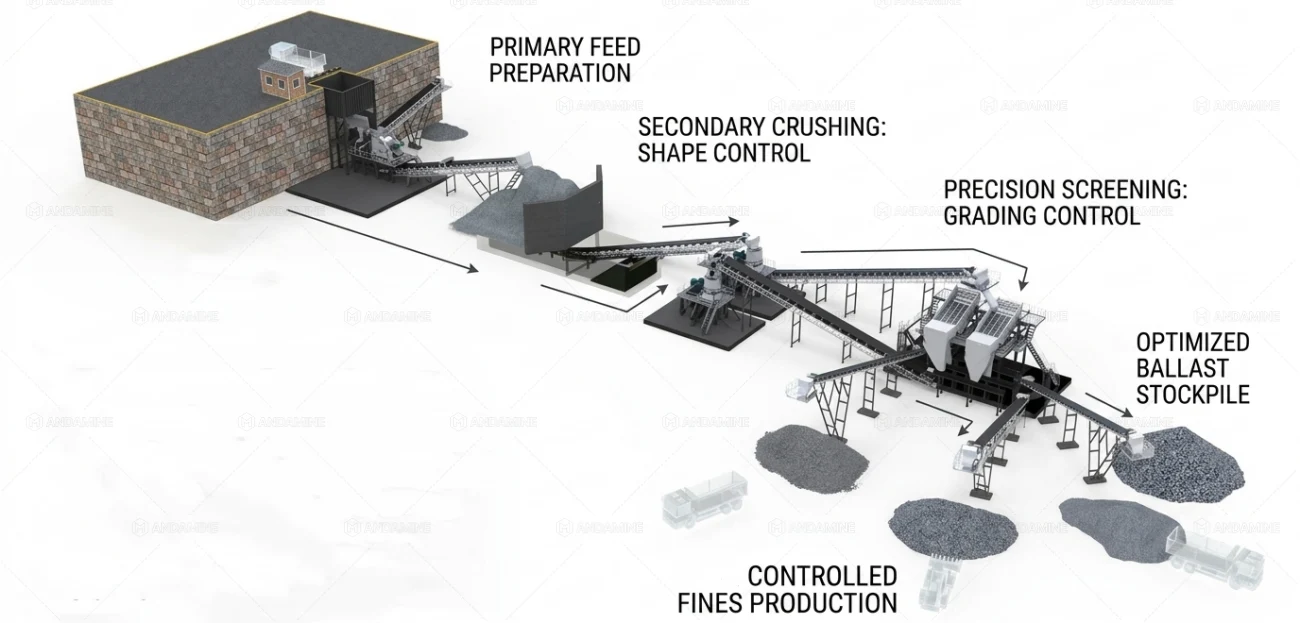
Primary Crushing: Preparing the Feed for Ballast Production
Primary crushing reduces large run-of-mine rock into a manageable feed for subsequent processing. The priority at this stage is to establish suitable feed conditions rather than produce finished ballast.
- Feed size: Reducing oversized rock creates a more consistent feed for downstream stages.
- Material flow: Stable feed conditions support more consistent crushing and screening performance.
- Initial reduction: The reduction should be sufficient for further processing without unnecessary size reduction.
The primary stage therefore prepares the material for controlled downstream processing.
Secondary and Tertiary Crushing: Controlling Size and Particle Shape
Further crushing brings the material closer to the required ballast size while also influencing particle shape.
- Size reduction: Additional stages progressively reduce material toward the target product range.
- Particle shape: Crushing conditions can influence the proportion of angular, flaky, and elongated particles.
- Fines generation: Excessive reduction can increase fine material and reduce usable ballast yield.
- Recirculation: Material outside the target range may be returned for further processing.
The required number of crushing stages depends on the feed material and finished-product requirements. More crushing does not necessarily mean better ballast.
Crusher Settings: Balancing Product Quality and Yield
Crusher operating conditions can affect product characteristics and production efficiency. Changes in settings, feed conditions, throughput, or equipment wear may alter the size distribution, particle shape, and amount of fines produced.
- Crusher setting: The opening between crushing surfaces influences the size of material leaving the crushing stage.
- Feed conditions: Variations in feed size, hardness, or composition can change the crushing response.
- Throughput: Excessive feed rates may reduce process stability and product consistency.
- Wear condition: Progressive wear can gradually change crushing performance and influence the final product.
The objective is to achieve the required ballast quality at a stable production rate and acceptable yield rather than simply maximize throughput.
Screening: Controlling the Final Ballast Grading
Screening separates material into different size fractions and plays a critical role in controlling ballast grading.
- Size separation: Particles are separated according to the required finished-product size range.
- Oversize control: Oversized material can be removed or returned for further processing.
- Undersize control: Fine material can be separated to limit excessive fines in the finished ballast.
- Product consistency: Stable screening performance helps maintain a uniform particle-size distribution.
Effective ballast processing requires crushing and screening to work as an integrated system. The goal is not maximum crushing output, but a consistent ballast product that meets the required size, shape, cleanliness, and yield targets.
Designing a Ballast Production System Around Product Requirements
A railway ballast production system should be designed around the required finished product, not around a particular crushing plant setup. Target grading, particle characteristics, production volume, and project conditions should guide decisions about processing stages, capacity, and material handling.
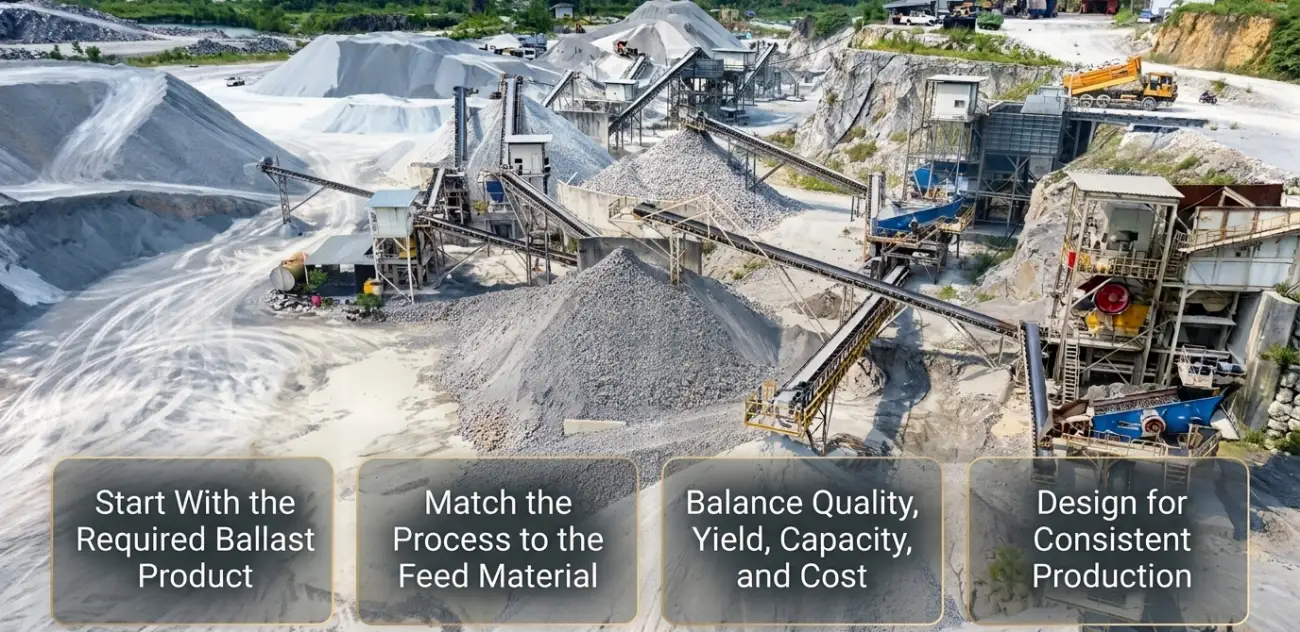
Start With the Required Ballast Product
The starting point for plant design should be a clear understanding of the ballast required by the railway project.
- Target grading: The required particle-size distribution determines how material needs to be reduced and separated.
- Particle characteristics: Shape, fines content, and other quality requirements influence the required level of process control.
- Production volume: Expected ballast demand determines the required capacity and production schedule.
Defining the finished product first prevents the system from being designed around equipment capabilities that may not match the actual project requirements.
Match the Process to the Feed Material
The same ballast specification may require different processing approaches depending on the available rock.
- Rock characteristics: Hardness, toughness, fracture behavior, and geological variability influence how the material responds during processing.
- Feed size: The size and consistency of incoming material affect the required reduction stages and process stability.
- Material variability: Changes between quarry areas or benches may require adjustments to the processing approach.
The processing system should therefore be matched to the actual relationship between the source material and the required ballast product.
Balance Quality, Yield, Capacity, and Cost
Ballast plant design involves several competing considerations. Additional processing may improve product control, but can also increase energy consumption, wear, recirculation, and maintenance requirements.
- Quality: The system must consistently produce ballast that meets the required specifications.
- Yield: Excessive fines or rejected material can reduce the proportion of feed converted into usable ballast.
- Capacity: The system needs sufficient output to meet project demand without relying on continuous peak operation.
- Cost: Capital investment, energy, wear parts, maintenance, and material handling all contribute to the cost per tonne.
The most economical design is therefore not necessarily the one with the lowest initial investment or highest nominal capacity, but the one that provides the required product at a sustainable operating cost.
Design for Consistent Production
Railway projects often require a dependable ballast supply over extended periods. The production system should therefore remain stable under normal variations in feed material and demand.
- Product consistency: Grading and particle characteristics should remain within the required range throughout production.
- Operational stability: The system should tolerate normal changes in feed conditions without significant loss of performance.
- Maintenance planning: Wear, servicing, and downtime should be considered when planning long-term operation.
- Supply reliability: Production capacity and stock management should be aligned with changing project demand.
Reliable crushing plant equipment is an important part of maintaining consistent ballast production. Andamine provides crushing solutions designed for stable size reduction and controlled aggregate production, helping producers process suitable rock into railway ballast that meets project requirements. Equipment selection should ultimately be based on feed characteristics, required product specifications, capacity, and long-term operating conditions.
Where Should Railway Ballast Be Produced?
Ballast production location directly impacts transportation costs and project efficiency. The ideal choice depends on local rock resources, haulage distance, and total project economics.
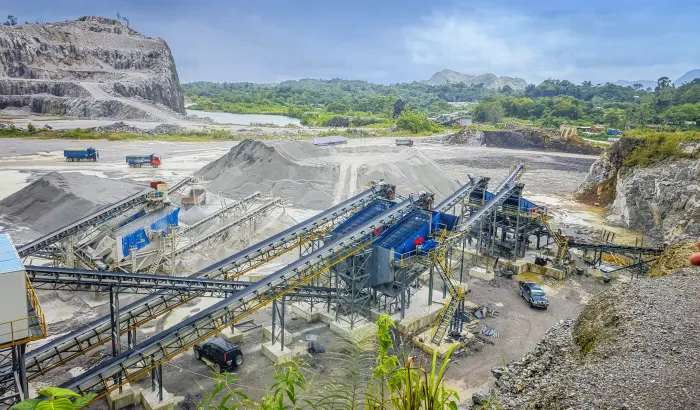
Centralized Quarry-Based Production
A centralized quarry is generally suitable when a railway project requires a large and continuous supply of ballast over an extended period.
- Stable demand: Consistent ballast demand can justify a dedicated production operation.
- Existing infrastructure: Established roads, stockpiles, utilities, and processing facilities can simplify production and handling.
- Long-term utilization: A centralized facility may supply different sections of the railway or future projects.
The main advantage is operational continuity. However, its economic benefit can decrease when the construction area is far from the quarry and transportation becomes a major part of the delivered cost.
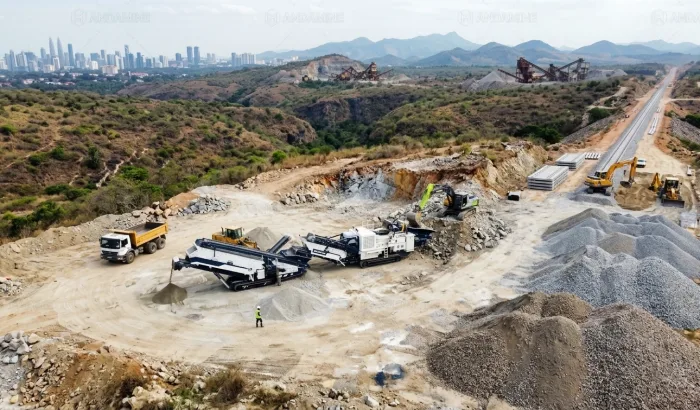
Near-Site Production for Remote Projects
Producing ballast closer to the railway construction area can be attractive when established aggregate sources are distant or difficult to access.
- Haulage distance: Shorter transport routes can reduce fuel use, vehicle requirements, and delivery costs.
- Remote terrain: Difficult access to existing quarries can make local production more practical.
- Local rock availability: Suitable rock near the construction corridor can provide an alternative ballast source.
However, near-site production is not automatically more economical. Transportation savings should be compared with the costs of establishing and operating production at the project location.
Why Haulage Distance Matters
Ballast is a high-volume material, so transportation can represent a significant share of its delivered cost. Longer haul distances increase the importance of fuel consumption, vehicle requirements, road conditions, and loading and unloading.
Therefore, quarry production cost alone does not determine project economics. A lower-cost ballast source may become less competitive after transportation and handling costs are included.
Choose the Location Based on the Whole Project
There is no universal choice between centralized and near-site production. The better option depends on distance, ballast volume, project duration, local rock availability, and infrastructure.
| Project Condition | More Suitable Approach |
|---|---|
| Large volume + long project duration | Centralized production |
| Long haul distance + remote site | Near-site production |
| Suitable local rock available | Near-site production may be attractive |
| Established quarry close to project | Centralized production |
| Short-term or changing work locations | Near-site production may be considered |
The best location is ultimately the one that provides reliable ballast supply at the lowest practical delivered cost while maintaining the required product quality.
Quality Assurance From Quarry to Railway Track
Railway ballast quality cannot be ensured by final product testing alone. Geological conditions, production processes, equipment, and handling all affect quality, requiring control throughout the entire process from quarry to track.
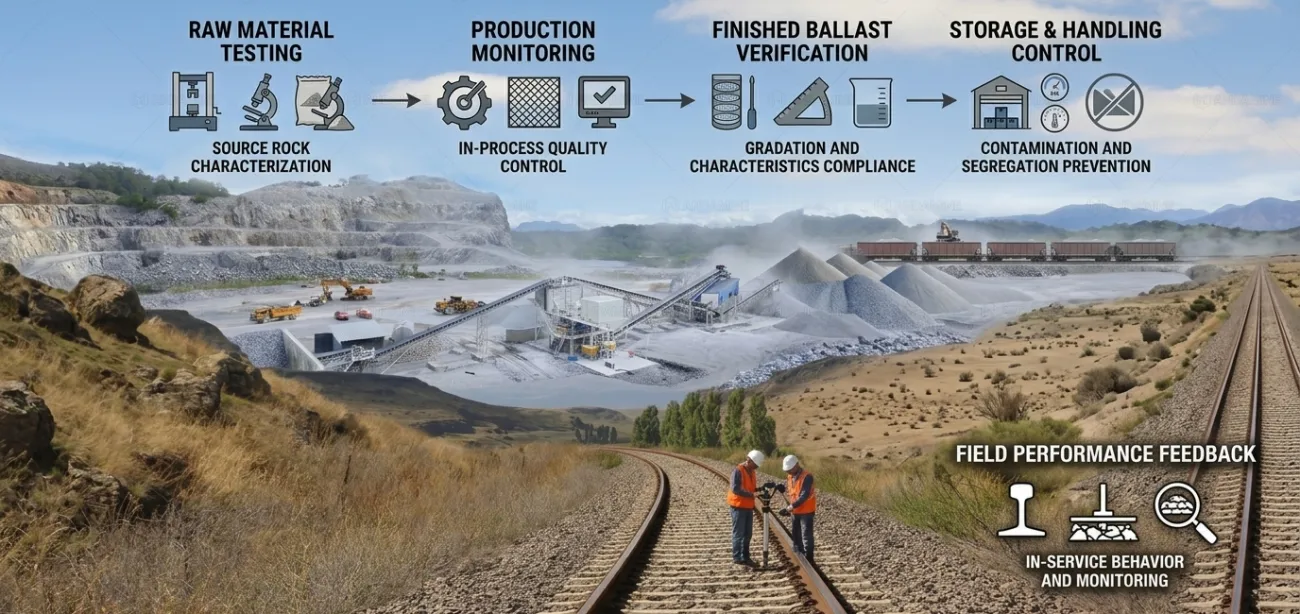
Test the Raw Material Before Production
Quality control begins with understanding whether the source material can consistently support ballast production.
- Material characteristics: Evaluate strength, durability, and abrasion resistance before large-scale production.
- Geological variation: Identify weathered zones, weak layers, and changes between quarry benches.
- Source consistency: Confirm that suitable material is available throughout the expected production period.
Monitor Changes During Production
Production conditions should be monitored alongside finished-product quality because changes in feed or equipment can affect the final ballast.
- Feed conditions: Changes in feed size or rock characteristics can alter crushing performance.
- Process performance: Crushing and screening conditions influence grading, particle characteristics, and fines generation.
- Equipment condition: Progressive wear can gradually affect product consistency.
Verify the Finished Ballast
Finished ballast should be regularly tested against applicable railway standards and project specifications.
- Grading: Confirm that particle-size distribution remains within the required range.
- Particle characteristics: Check shape and related requirements.
- Cleanliness and durability: Verify fines content and relevant durability properties.
Control Storage and Material Handling
Ballast quality can also be affected after processing. Stockpiling, loading, transportation, and site handling may cause contamination, segregation, or particle breakdown.
- Stockpile management: Reduce segregation and contamination between material fractions.
- Material handling: Limit unnecessary particle degradation during loading and transfer.
- Delivery condition: Ensure the material delivered to the project remains representative of the tested product.
Use Field Performance as Feedback
Laboratory testing confirms compliance, while field performance shows how ballast behaves under actual railway conditions.
- Track behavior: Settlement, geometry changes, and ballast movement can reveal performance issues.
- Ballast condition: Fouling, drainage changes, and particle degradation provide evidence of in-service behavior.
- Production feedback: Field observations can be compared with production and laboratory data to identify potential causes.
Quality control provides the foundation for reliable ballast performance, but maintaining long-term competitiveness requires continuous improvement beyond current production practices. Advances in technology, resource management, and processing strategies are creating new opportunities to improve the efficiency and reliability of ballast production.
The Future of Railway Ballast Production
Railway development is creating new demands for ballast performance, production efficiency, and resource utilization. Future production will focus not only on meeting specifications, but also on achieving more consistent quality, optimized resource use, and lower environmental impact.
Higher Performance Requirements
- Heavier axle loads: Greater loading increases demands on ballast resistance to degradation and deformation.
- Higher train speeds: Increased dynamic effects can accelerate particle movement and deterioration.
- Longer service life: Ballast needs to maintain stable performance over longer maintenance intervals.
More Data-Driven Quality Management
- Continuous monitoring: Production and quality data can help identify changes earlier than periodic testing alone.
- Predictive maintenance: Equipment data can indicate wear before it significantly affects product consistency.
- Process optimization: Data analysis can support more accurate adjustments to production conditions.
More Efficient Use of Quarry Resources
- Higher material utilization: Better production control can increase the proportion of suitable ballast recovered from available rock.
- Less over-processing: Avoiding unnecessary crushing can reduce energy consumption and equipment wear.
- Resource planning: Geological variability can be considered when managing long-term quarry production.
Alternative Materials and Sustainable Production
- Recycled ballast: Reused ballast and other recycled materials may provide additional sources for railway construction where requirements permit.
- Alternative aggregates: Materials such as steel slag may offer additional options when their engineering properties meet relevant specifications.
- Lower environmental impact: More efficient production can reduce energy use, material waste, and the overall impact of ballast supply.
Reliable railway ballast production is ultimately about maintaining the right balance between quality, consistency, efficiency, and long-term performance. When quarry selection, processing, quality control, and logistics are considered as one system, producers can achieve more dependable ballast supply while making better use of available resources.