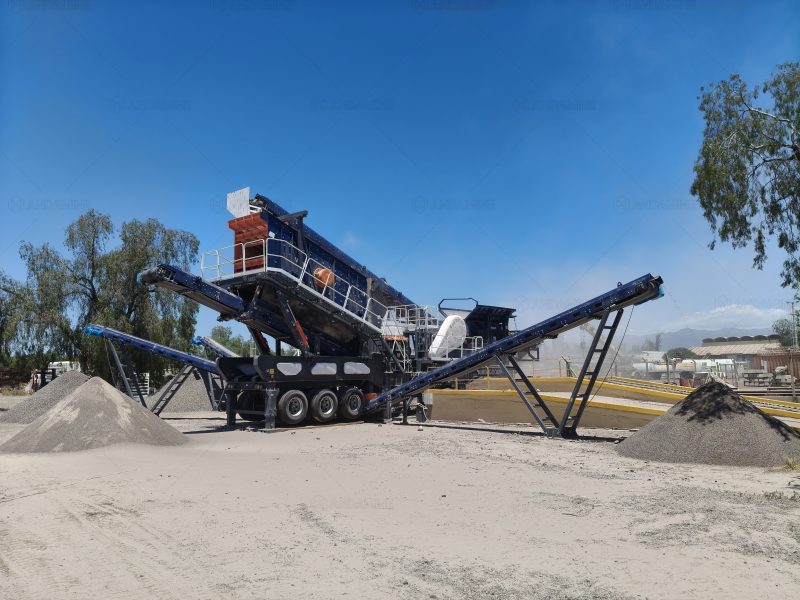
A basalt crusher is essential for transforming hard, abrasive rock into high-quality aggregates for roads, railways, and construction projects. Because basalt causes significant wear on equipment, selecting a properly designed crushing system is critical for achieving stable production, superior particle shape, and lower operating costs. The right solution can significantly improve plant efficiency and long-term profitability.
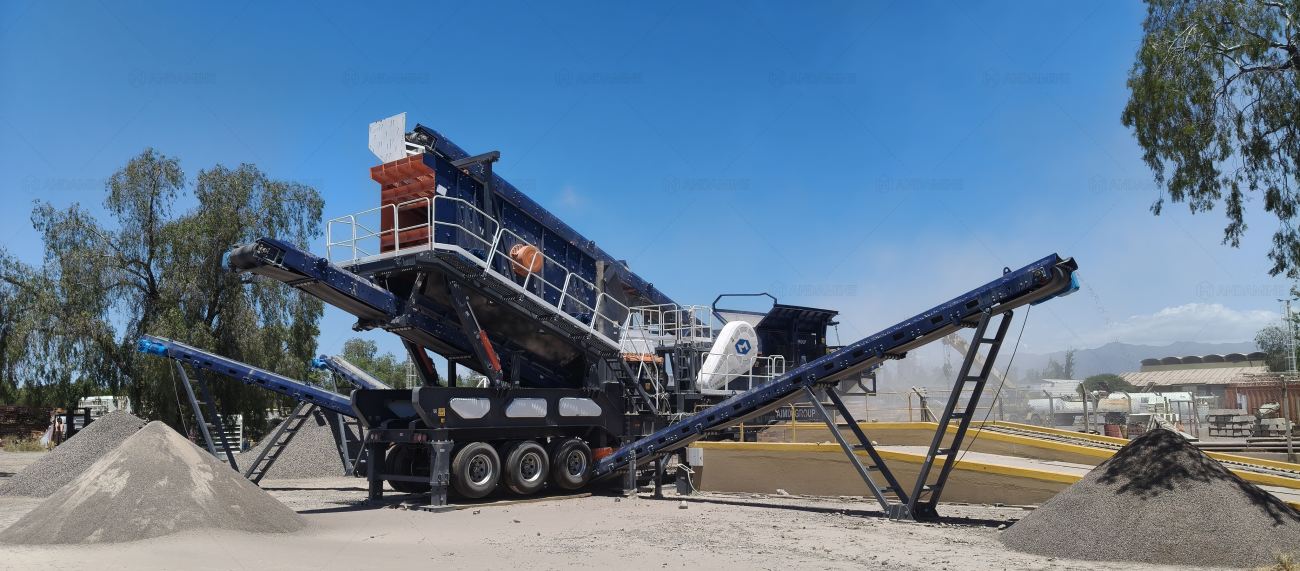
Why Is Basalt Difficult to Crush?
Basalt is widely used in road construction, railway ballast, and high-strength concrete production. However, compared with softer rocks such as limestone or sandstone, basalt is significantly more difficult to process. Its dense geological structure results in high hardness and strong abrasiveness, which directly increases crushing resistance and equipment wear.
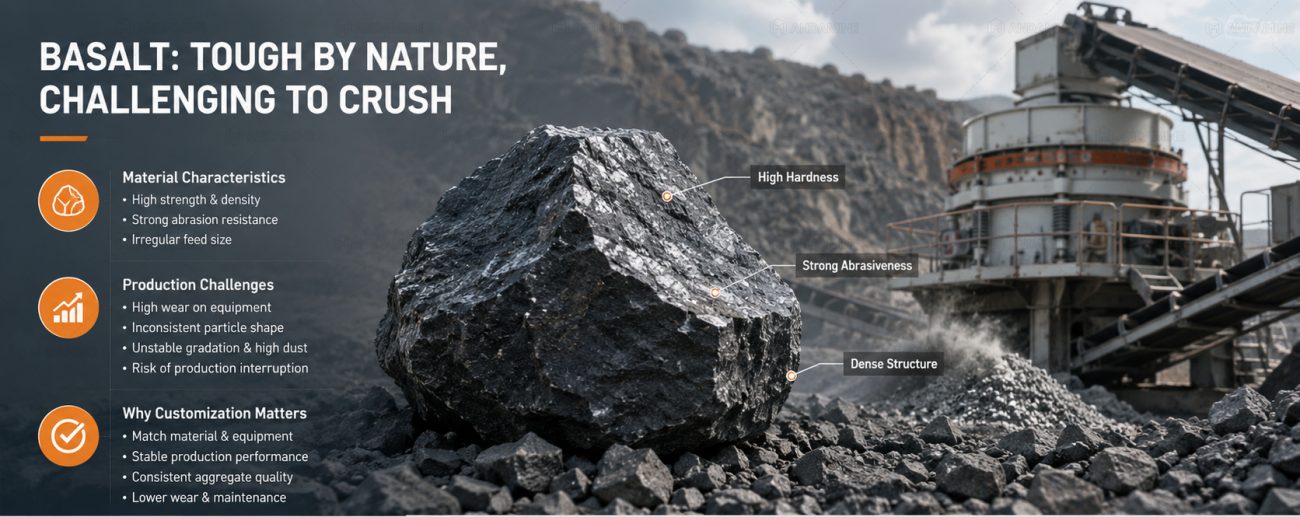
Understanding Basalt Material Characteristics
Basalt is an igneous rock formed by rapid cooling of lava, creating a dense crystalline structure with low porosity.
Key characteristics affecting crushing performance:
- High compressive strength and density: Requires higher crushing force and increases energy demand.
- Strong abrasion resistance: Accelerates wear of key crusher components during continuous operation.
- Irregular feed size from blasting: Oversized and uneven feed reduces initial crushing efficiency if not properly controlled.
These properties mainly affect crushing resistance, wear rate, and feed stability in production.
Common Challenges in Basalt Aggregate Production
In real quarry operations, basalt processing often leads to several operational challenges:
- Faster wear of wear parts, increasing maintenance demand.
- Difficulty achieving consistent particle shape under standard crushing setups.
- Unstable gradation caused by uneven feed conditions.
- High dust generation requiring additional environmental control.
- Increased risk of production interruption under heavy load.
These challenges mainly impact operating cost, product quality, and production stability, especially in long-term continuous production.
Why a Customized Crushing Solution Matters
Basalt processing requirements vary significantly depending on project scale, feed conditions, and final application. Different projects may require different aggregate specifications for road base, asphalt, concrete, or railway ballast.
A well-designed crushing system helps ensure:
- Proper matching between material conditions and equipment selection.
- Stable and continuous production performance.
- Consistent aggregate quality for downstream applications.
- Lower long-term wear and maintenance pressure.
Therefore, crushing system design should be considered at the planning stage to ensure overall production efficiency and project profitability.
Recommended Basalt Crusher Solutions for Different Projects
Different basalt crushing projects require different plant configurations based on production scale, site conditions, mobility requirements, and long-term operation plans. Instead of focusing only on capacity, basalt crusher solutions are generally divided into two main categories: stationary and mobile crushing plants. Each type is designed for different working environments and project goals.
Mobile Basalt Crushing Plants: Wheel Type and Track-mounted Type
Mobile basalt crushing plants are self-contained systems designed for crushing hard and abrasive basalt at different job sites. Mounted on wheels or crawler tracks, they allow fast relocation and efficient on-site crushing without fixed foundations.
By processing basalt closer to the source, they help reduce transport distance and improve overall production efficiency in hard rock aggregate operations. Compared with stationary plants, mobile basalt crushing solutions offer greater flexibility while maintaining stable output performance.
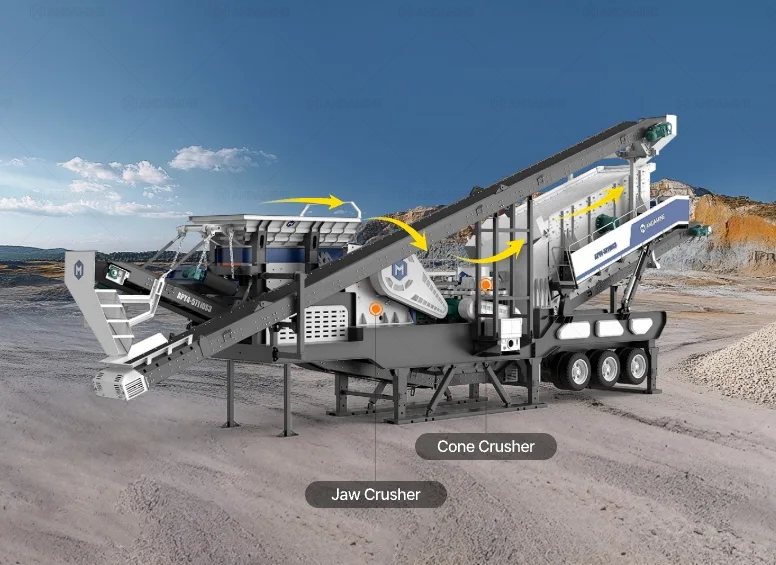
Wheeled Type APY4-S 4 In 1 Mobile Crushing Plant
One-click start, Intelligent operation, Efficient production
- Configuration: Vibrating feeder + Primary jaw crusher + Adjustable Secondary Crusher(cone crusher, impact crusher, or fine jaw crusher) + Vibrating screening
- Capacity: 30-200tph
- Feeder Size(mm): <500
- Output Size(mm): 5-80
- Features:
①Modular design: Secondary crushers (impact, sand maker) can be swapped for flexible combinations.②ROSTA vibration supports: Reduce startup/shutdown vibration and extend service life.
③Side-mounted vibrating motor: Maintenance-free, 1,500–2,000 hours service interval.
④Self-discharging iron remover: Strong magnetic field prevents iron damage to cone crushers.
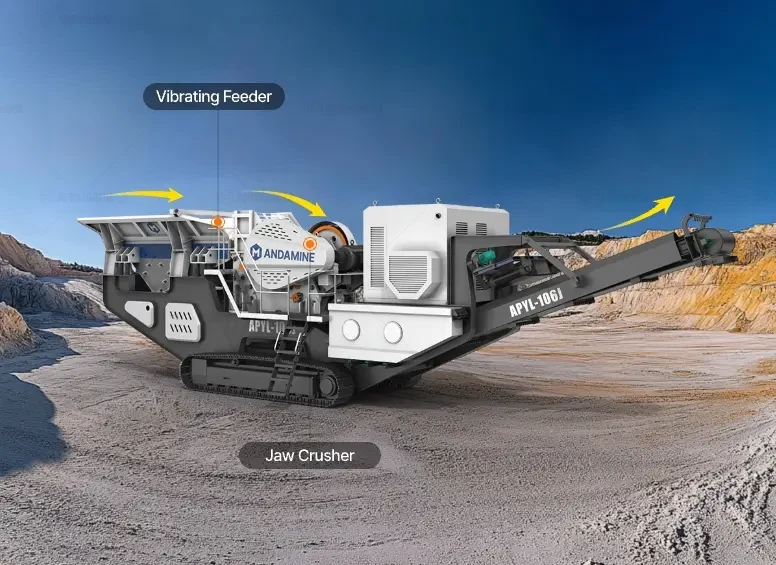
Track-Mounted Mobile Jaw Crusher
- Capacity: 80-415tph
- Feeder Size(mm): <700
- Output Size(mm): 60-250
- Features:
①All-Terrain & Zero Foundation: Crawler-mounted mobile jaw crusher moves freely on slopes, wetlands, or rough terrain without leveling or concrete foundations.②Reliable Hydraulic System: Global components (e.g., Rexroth) ensure efficient, responsive, and low-maintenance operation under heavy loads.
③Reinforced Undercarriage: Steel boat-shaped chassis with high clearance and 360° rotation provides stability, off-road capability, and strong load support.
- Crushers: Available with jaw, cone, or impact crushers.
Stationary Crushing Plants: Long-Term Reliability for Large-Scale Basalt Aggregate Production
Stationary basalt crusher plants are fixed installations designed for long-term, high-capacity processing of hard and abrasive basalt. Built on a stable foundation, they are ideal for continuous large-scale aggregate production in quarry and infrastructure projects.
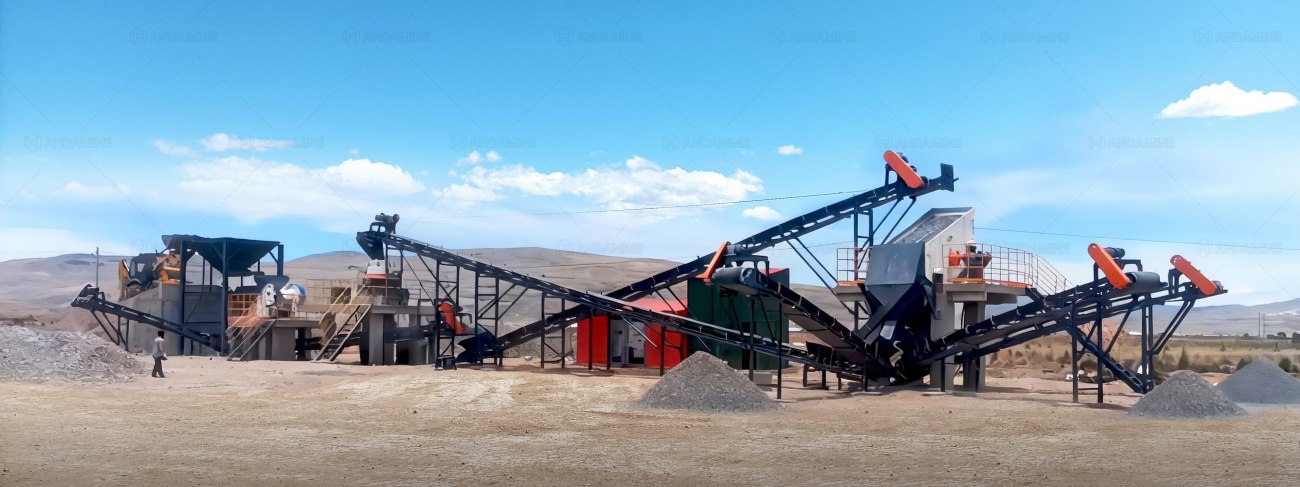
- Designed for large-scale basalt crushing operations
- Heavy-duty structure for processing high-hardness materials
- Integrated multi-stage crushing and screening lines
- Can be equipped with advanced automation and centralized control systems
- Efficient processing of hard basalt with stable output
- High production capacity suitable for continuous operation
- Lower downtime with optimized system design and wear management
- Better cost efficiency for long-term aggregate production projects
- Large basalt quarries and aggregate production plants
- Highway, railway, and infrastructure base material supply
- Long-term mining and construction material processing projects
How Is Basalt Processed Into Construction Aggregates?
Basalt is processed into construction aggregates through a continuous multi-stage crushing and screening system. During this process, large raw basalt rocks are gradually reduced in size, reshaped, and classified into different grades of finished aggregates used in infrastructure construction such as roads, railways, and concrete production.
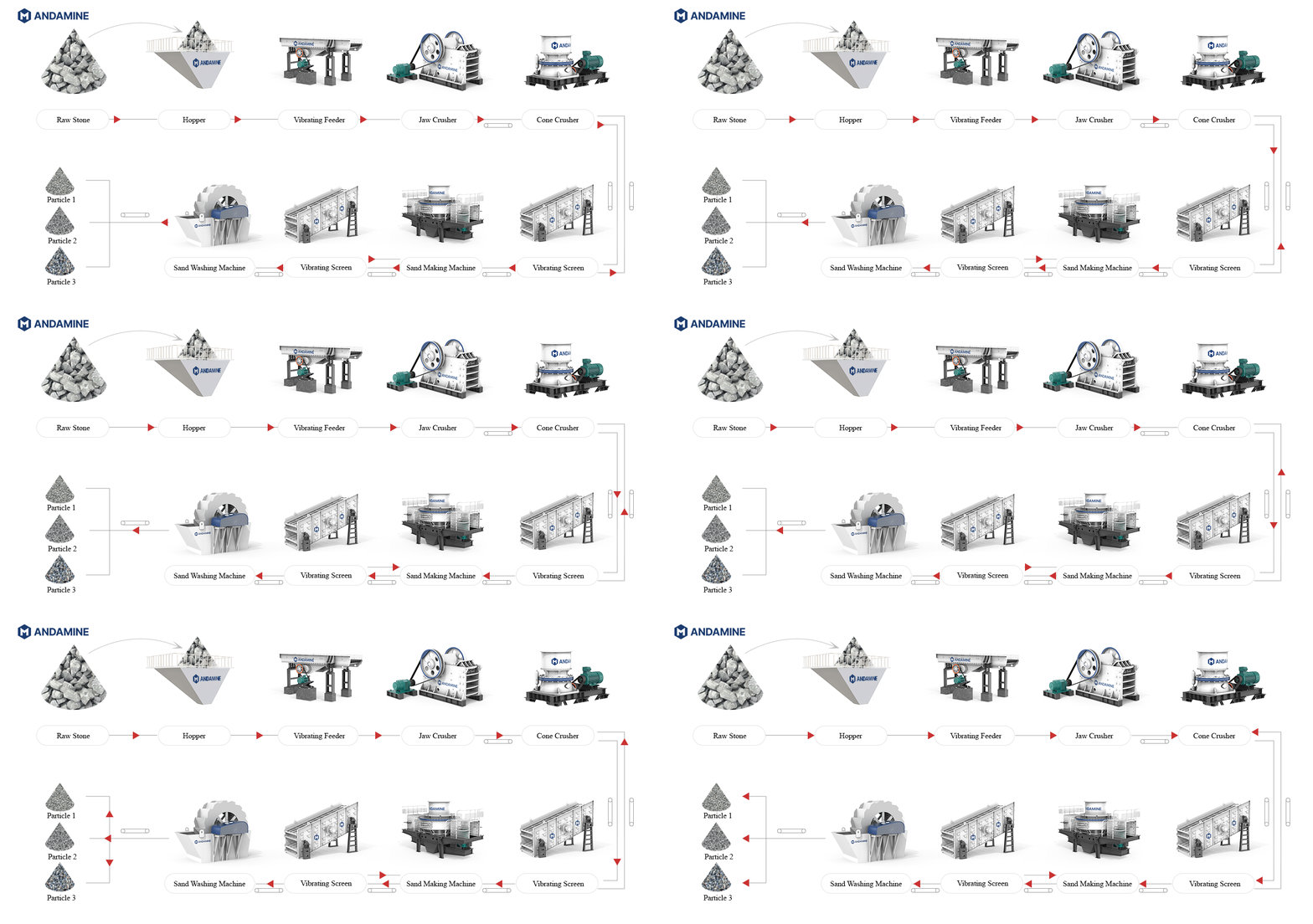
Primary Crushing – Breaking Large Basalt Rocks
The process begins with primary crushing, where large basalt rocks (typically 500–1500 mm) are fed into the crushing system and reduced to medium-sized fragments of around 100–300 mm.
This stage focuses on initial size reduction and ensures that oversized raw materials are broken down into manageable pieces. Stable and continuous feeding is important here, as it helps maintain smooth operation of the entire production line and prevents unnecessary load fluctuations in downstream processes.
Secondary Crushing – Reducing Material Size
After primary crushing, the material is transported to the secondary crushing stage, where it is further reduced into smaller and more uniform particles.
This stage plays an important role in improving overall size consistency and bringing the material closer to the required specifications for construction aggregates. A well-controlled secondary crushing process helps stabilize production and prepares the material for final shaping.
Shaping Process – Improving Aggregate Quality
In the shaping stage, the crushed basalt is further processed to improve particle form and overall quality.
Irregular and elongated particles are gradually reduced, while more cubic-shaped aggregates are produced. This improvement in particle shape is essential for enhancing the performance of concrete and asphalt applications, where strength and durability depend heavily on aggregate quality.
Screening and Classification – Final Product Separation
In the final stage, the processed material is sent to a screening system, where it is separated into different size fractions according to construction requirements.
Typical product sizes include: 0–5 mm fine aggregate, 5–10 mm small aggregate, 10–20 mm standard aggregate and 20–40 mm coarse aggregate.
Each size fraction is collected separately and used in different applications such as concrete mixing, asphalt production, road base construction, and structural filling materials.
What is Crushed Basalt Used for?
Crushed basalt is a widely used construction material due to its high strength, durability, and resistance to wear. After being processed through crushing and screening, it is separated into different size ranges and applied in various infrastructure and industrial projects.
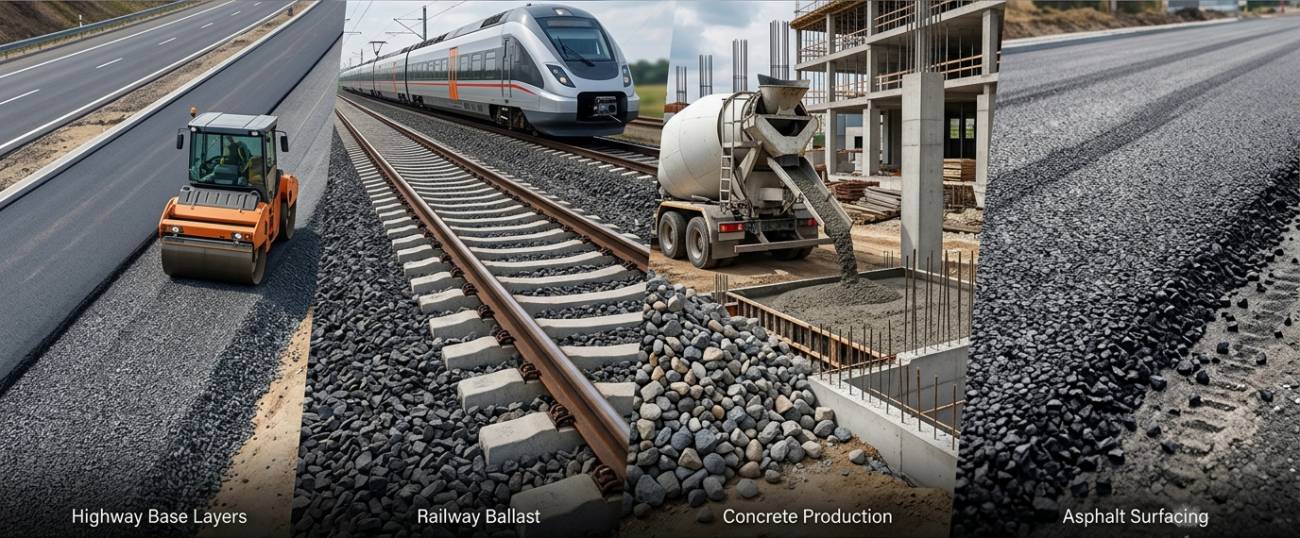
Road Construction and Highway Base Layers
Crushed basalt rock is commonly used in road base and sub-base layers due to its high compressive strength. It helps improve pavement stability and reduces deformation under heavy traffic loads, making it suitable for highways and urban road systems.
Railway Ballast Applications
In railway engineering, basalt aggregates are used as ballast to support sleepers and maintain track stability. Its hardness and resistance to weathering allow it to perform well under continuous vibration and heavy load conditions.
Concrete Production
Crushed basalt is widely used in ready-mix concrete plants. Its stable grading and high strength contribute to improved concrete durability, making it suitable for structural and commercial construction projects.
Asphalt and Surface Layer Materials
In asphalt mixtures, basalt aggregates are valued for their angular shape and strong interlocking properties. This helps improve road surface friction, durability, and resistance to rutting under high temperatures.
How to Choose the Right Basalt Crushing Equipment?
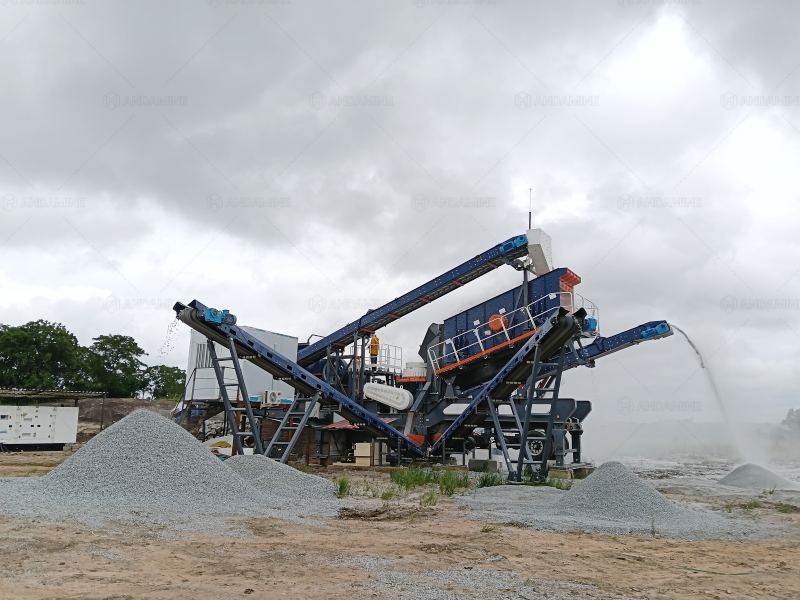
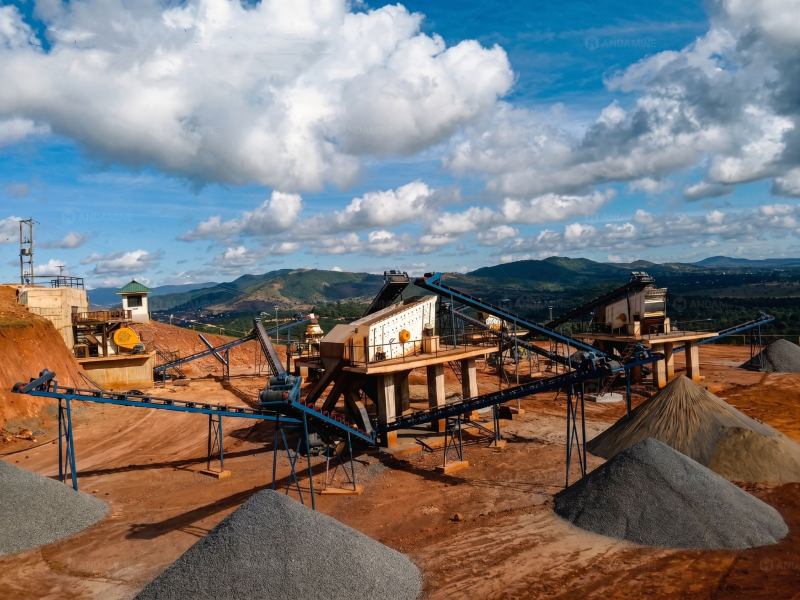
Selecting basalt crushing equipment requires evaluating material conditions, required aggregate quality, production capacity, and site constraints together. In real quarry projects, the right configuration is not determined by a single machine, but by how well the entire system matches actual operating conditions such as rock hardness, feeding stability, and end-product requirements.
The following factors provide a practical guide to help you make a more reliable selection for long-term basalt crushing operations.
Consider Basalt Hardness and Evaluate Wear Conditions
Before selecting any equipment, it is important to understand how abrasive your basalt is in real crushing conditions, since this directly affects wear cost and equipment lifespan.
- High hardness basalt increases wear on crushing components: Hard basalt accelerates wear on jaw plates, cone liners, and other consumable parts. This leads to more frequent maintenance and should be considered when planning long-term operating costs.
- Wear conditions should be based on material testing or historical quarry data: Equipment selection should rely on real material testing results or previous production experience rather than theoretical assumptions, since actual wear performance can vary significantly between quarries.
- Wear cost should be considered from the beginning of system design: In high-abrasion conditions, maintenance cost is a core part of overall investment planning and should not be treated as an afterthought during operation.
Evaluate Feed Size and Feeding Stability
Feed conditions determine whether the crushing line can operate continuously and efficiently without bottlenecks.
- Oversized feed requires stronger primary crushing capacity: Large basalt blocks increase the load on the primary crusher and require sufficient reduction capability to ensure stable downstream processing.
- Uneven feed affects production stability and energy efficiency: Irregular material flow can cause fluctuations in crushing chamber load, leading to unstable output and higher energy consumption per ton.
- Stable feeding is essential for continuous production: Even a high-capacity crusher cannot perform efficiently without consistent and controlled feeding conditions.
Define Aggregate Quality Requirements Based on Application
Different construction applications require different levels of control over particle shape, grading, and consistency.
- Concrete applications require stable grading: Consistent particle size distribution is necessary to ensure uniform mixing performance and structural strength.
- Asphalt applications require better particle shape: Cubical particles improve bonding with bitumen, while flaky particles may reduce road durability and long-term performance.
- High-grade projects require stricter control of fines and particle distribution: The more demanding the application, the more important shaping and screening control become in the crushing process.
Determine Capacity Based on Real Production Demand
Capacity should be selected based on actual operating conditions rather than nominal equipment ratings.
- Real output is usually lower than theoretical capacity: Production is influenced by feeding stability, material hardness, and maintenance downtime, so practical output should be used for planning.
- Different demand levels require different system stability: Small-scale projects focus on basic output, while medium and large-scale operations require continuous and stable production performance.
- Future expansion should be considered during initial planning: System layout should allow capacity upgrades without requiring full reconstruction of the plant.
Evaluate Site Conditions and Installation Constraints
Site conditions play a key role in determining equipment layout and system configuration.
- Limited space requires compact system design: Material transfer distance should be minimized to maintain stable and efficient flow between crushing stages.
- Remote locations require easier installation and transport solutions: Modular or pre-assembled systems are often more suitable for difficult terrain or limited access areas.
- Long-term projects prioritize operational efficiency over flexibility: Fixed installations typically focus more on automation, stability, and long-term cost control.
What Determines the Performance of a Basalt Crushing Plant?
After selecting the right crushing equipment configuration, the overall performance of a basalt crushing plant is determined by how well the system operates under real production conditions. In hard rock processing, differences in output stability, wear cost, and downtime are usually caused by system-level factors rather than individual machines. Understanding these key factors helps identify performance bottlenecks and optimize long-term production efficiency.
System Design Quality and Equipment Coordination
Plant performance is largely determined by how well each crushing stage is integrated into a continuous and balanced production flow.
- Balanced process flow prevents bottlenecks and capacity loss: When primary, secondary, and screening stages are properly matched, material flow remains stable throughout the system. Poor balance between stages often leads to material backlog or underutilization of downstream equipment.
- Stage coordination is more important than individual machine strength: Even high-performance crushers cannot deliver expected output if upstream feeding or downstream screening is not synchronized. System efficiency depends on overall coordination rather than single-unit capacity.
- Improper configuration reduces real output efficiency: In practice, many plants operate below theoretical capacity not because of machine limitations, but due to system mismatch and inefficient material transfer.
Wear Behavior Under Continuous Basalt Processing
In basalt applications, wear conditions are one of the main factors affecting long-term operational stability and cost control.
- Wear distribution directly affects production continuity: Uneven wear on liners or crushing components can lead to unstable particle size output and frequent adjustment requirements during operation.
- Material quality of wear parts determines lifecycle performance: High-quality alloy materials significantly improve resistance to abrasion, especially in high-hardness basalt environments, reducing downtime caused by frequent replacement.
- Wear accumulation should be monitored as an operational indicator: In long-term projects, wear rate is not only a maintenance issue but also a key indicator of whether the system is properly matched to the material.
Automation Level and Process Stability Control
Automation plays a critical role in maintaining stable operation in basalt crushing plants, especially when feed conditions fluctuate.
- Real-time control improves system stability under variable load conditions: PLC-based systems adjust feeding, crushing load, and screening balance automatically, helping maintain consistent production even when material conditions change.
- Operational data monitoring helps prevent system overload: Continuous tracking of crusher load, vibration, and throughput allows early detection of abnormal operating conditions before failures occur.
- Optimized control reduces unnecessary energy and wear: Stable operating parameters reduce repeated overload cycles, which helps extend equipment lifespan and improve energy efficiency.
Maintenance Strategy and Spare Parts Readiness
Long-term performance in basalt crushing depends heavily on how effectively maintenance is planned and executed.
- Planned maintenance prevents unexpected production interruptions: Scheduled inspections and wear part replacement reduce the risk of sudden shutdowns that can affect overall production schedules.
- Maintenance accessibility affects downtime duration: Equipment designed for easier access to wear components significantly reduces repair time and improves plant availability.
- Spare parts availability determines operational resilience: Projects with stable spare parts supply chains can recover faster from wear-related interruptions, ensuring more consistent production output.
Investment Considerations for Basalt Crushing Projects
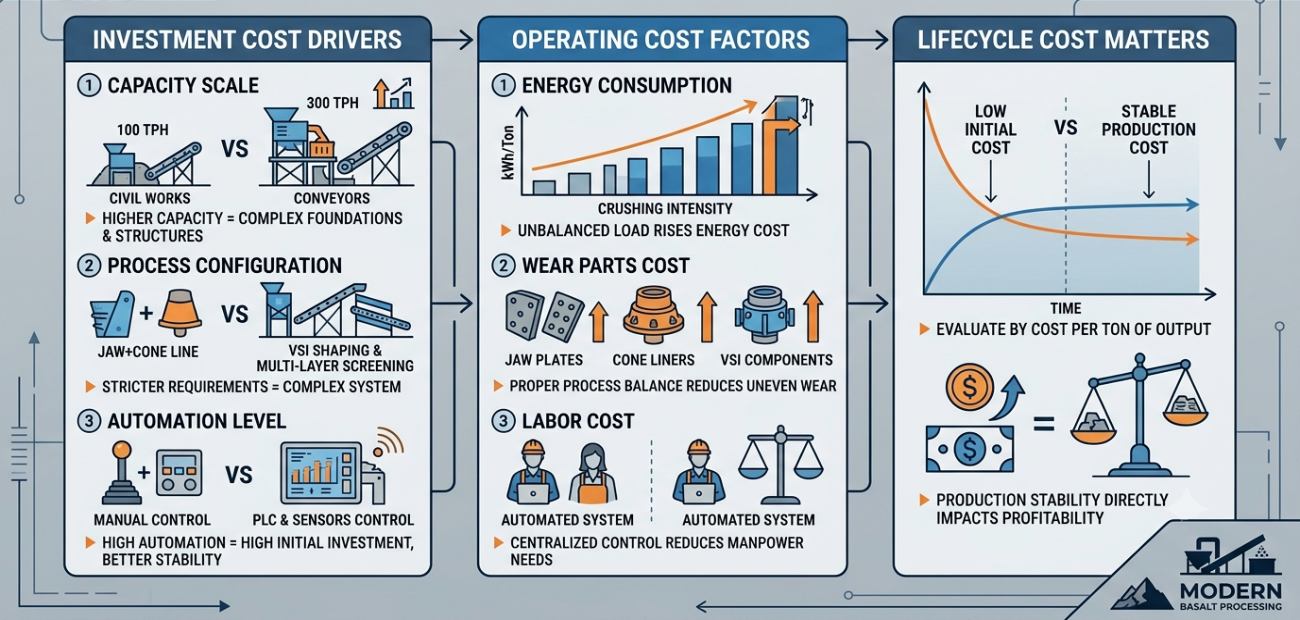
The investment of a basalt crushing plant is not only determined by equipment price, but more importantly by how the system performs under long-term abrasive working conditions. In real projects, two plants with similar configurations may have very different total costs due to capacity utilization, wear behavior, and operational efficiency.
Investment Cost Drivers
- Capacity scale affects system structure and civil work cost: Higher capacity is not just about larger crushers. It also requires wider conveyors, larger screening area, and stronger steel structures. For example, upgrading from a 100 TPH to 300 TPH system usually increases not only equipment cost, but also foundation and installation complexity.
- Process configuration determines product value and system cost balance: A basic crushing line may only include jaw + cone crushers, while high-grade aggregate production requires additional VSI shaping and multi-layer screening. The more strict the final aggregate requirement (especially for asphalt or concrete), the more complex the system becomes.
- Automation level affects operational dependency and stability: Simple systems rely heavily on manual control, which increases output fluctuation risk. Fully automated PLC systems improve stability but require higher initial investment in control cabinets, sensors, and integration.
Operating Cost Factors
- Energy consumption increases sharply with hard rock processing intensity: Basalt requires higher crushing force, especially in secondary and tertiary stages. Poor system design (such as over-crushing or unbalanced load) can significantly increase kWh per ton of output.
- Wear parts cost depends on crushing stage load distribution: Most wear occurs in jaw plates, cone liners, and impact/VSI components. If the process is not properly balanced, one stage may carry excessive load, leading to faster wear and uneven replacement cycles.
- Labor cost is driven by system complexity and automation level: Semi-automatic plants require more operators for feeding control, screening adjustment, and maintenance monitoring. In contrast, centralized control systems reduce manpower needs but require higher technical maintenance capability.
Why Lifecycle Cost Matters More Than Purchase Price
- Low-cost systems often reduce efficiency under real working conditions: Equipment selected only based on initial price may struggle with high abrasion conditions, leading to frequent downtime and unstable output.
- True investment should be evaluated by cost per ton of output: A more expensive system with stable production may achieve lower long-term cost per ton compared to a cheaper system with frequent maintenance interruptions.
- Production stability has a direct impact on project profitability: In aggregate supply contracts, delivery consistency is often more valuable than marginal savings in equipment purchase cost.
Future Trends in Basalt Crushing Technology
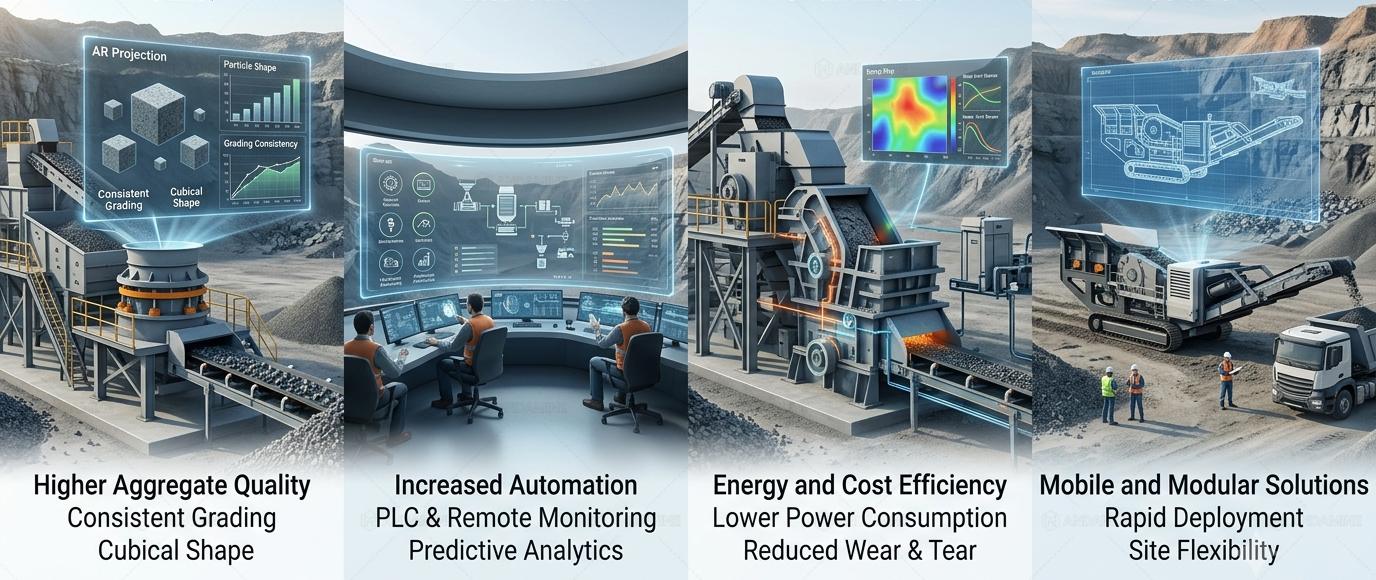
The basalt crushing industry is gradually evolving toward higher efficiency, better product quality, and more intelligent operation. These changes are mainly driven by stricter construction standards, rising material performance requirements, and increasing pressure on operating costs.
Higher Demand for Better Aggregate Quality
Future construction projects require more consistent grading and improved particle shape, especially for highway asphalt and high-strength concrete. This leads to wider adoption of multi-stage crushing and shaping systems to ensure better aggregate performance.
Growing Level of Plant Automation
Modern crushing plants are increasingly equipped with PLC control and monitoring systems. These technologies help improve production stability, reduce manual operation errors, and maintain consistent output quality under hard rock conditions.
Focus on Energy and Cost Efficiency
With rising energy and maintenance costs, future systems are designed to reduce power consumption and wear part usage per ton of output. Optimized crushing chambers and more balanced process layouts are becoming increasingly important.
More Flexible and Mobile Solutions
Mobile and modular crushing plants are gaining popularity in projects with changing site conditions. They allow faster installation, easier relocation, and more flexible production planning compared to traditional fixed plants.
FAQs of Basalt Crusher Plants
What machines are included in a basalt crusher plant?
What is the best crusher for basalt processing?
What affects the capacity of a basalt crushing plant?
What is the difference between cone crusher and impact crusher for basalt?
How much does a basalt crusher plant cost?
How often does a basalt crusher plant require maintenance?
A well-planned crushing setup ensures reliable performance under the demanding conditions of basalt processing and helps maintain consistent output quality throughout the project lifecycle. If you are planning a basalt crushing project, contact our professional team to get a tailored solution based on your material conditions and production requirements.