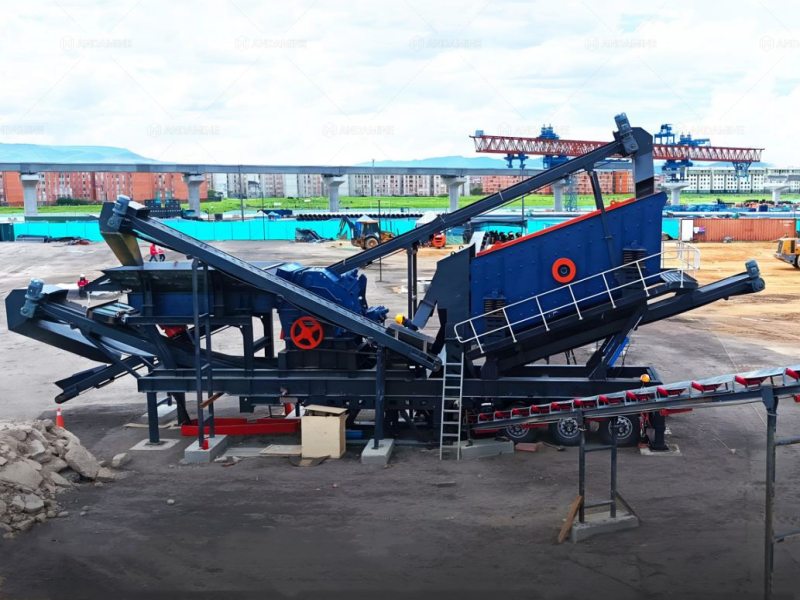
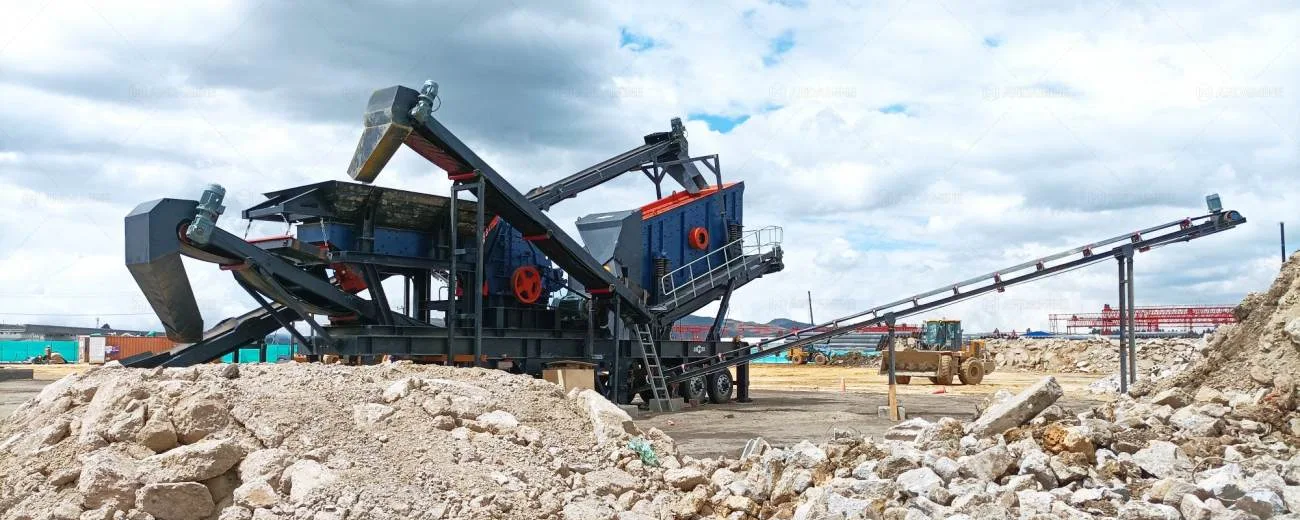
A concrete crusher turns demolition concrete, reinforced concrete, and precast waste into reusable aggregate, helping recover value from material that would otherwise be discarded. However, concrete crushing involves more than simply reducing the size of the material. Rebar, oversized blocks, variable feed conditions, and required aggregate gradation all influence the choice of equipment and process. The right configuration can produce consistent recycled concrete aggregate (RCA) for road base, backfill, and other construction applications.
What Types of Concrete Waste Can a Concrete Crusher Process?
A concrete crusher commonly processes demolition concrete, reinforced concrete, precast concrete, and returned or hardened concrete. The required crushing setup depends on the material’s size, reinforcement, and level of contamination.
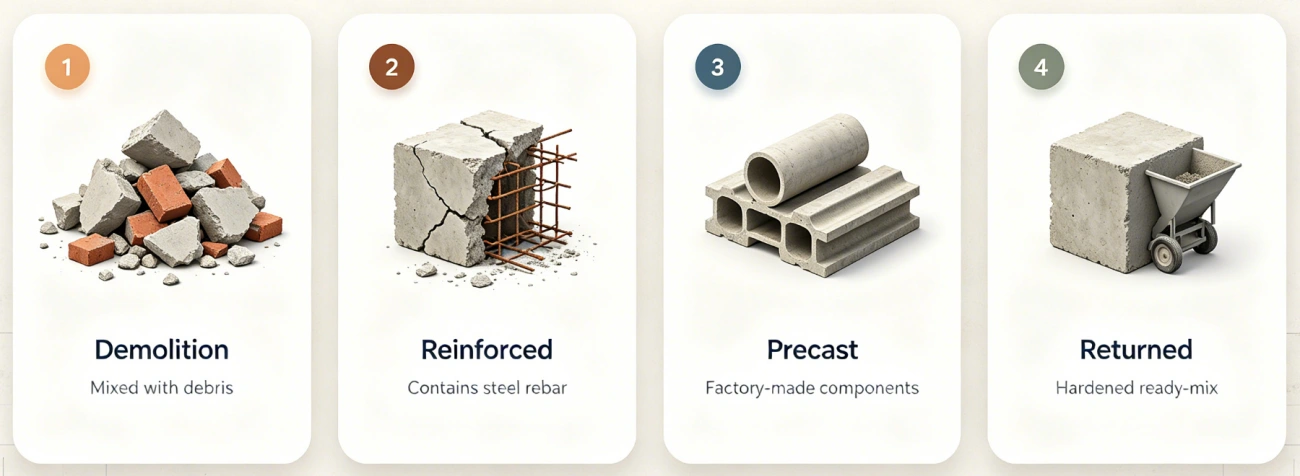
Demolition Concrete
Demolition concrete comes from buildings, foundations, slabs, bridges, and other structures. It commonly arrives as large, irregular pieces and may be mixed with bricks, asphalt, soil, or other debris. The size and cleanliness of the feed largely determine how much preparation is needed before crushing.
Reinforced Concrete
Reinforced concrete contains steel bars, wire mesh, or other embedded metal. When the concrete is broken, exposed steel can remain attached to large pieces or become tangled in the equipment. The steel content therefore needs to be considered when planning concrete crushing and metal separation.
Precast Concrete
Precast waste includes damaged or rejected pipes, panels, beams, paving products, and other factory-made components. It is often more consistent and cleaner than mixed demolition concrete, making the feed easier to predict. However, the shape and dimensions of large precast elements still need to match the feeding and crushing system.
Returned and Hardened Concrete
Ready-mix concrete that cannot be placed before hardening can become a recyclable solid material. Because it usually comes from a controlled production source, it may contain fewer contaminants than demolition concrete. Its hardened block size and the required recycled aggregate size are the main factors to consider when processing it.
What Makes Concrete Crushing Challenging?
Rebar, oversized concrete, mixed debris, and different output requirements make concrete crushing more demanding than ordinary rock crushing.
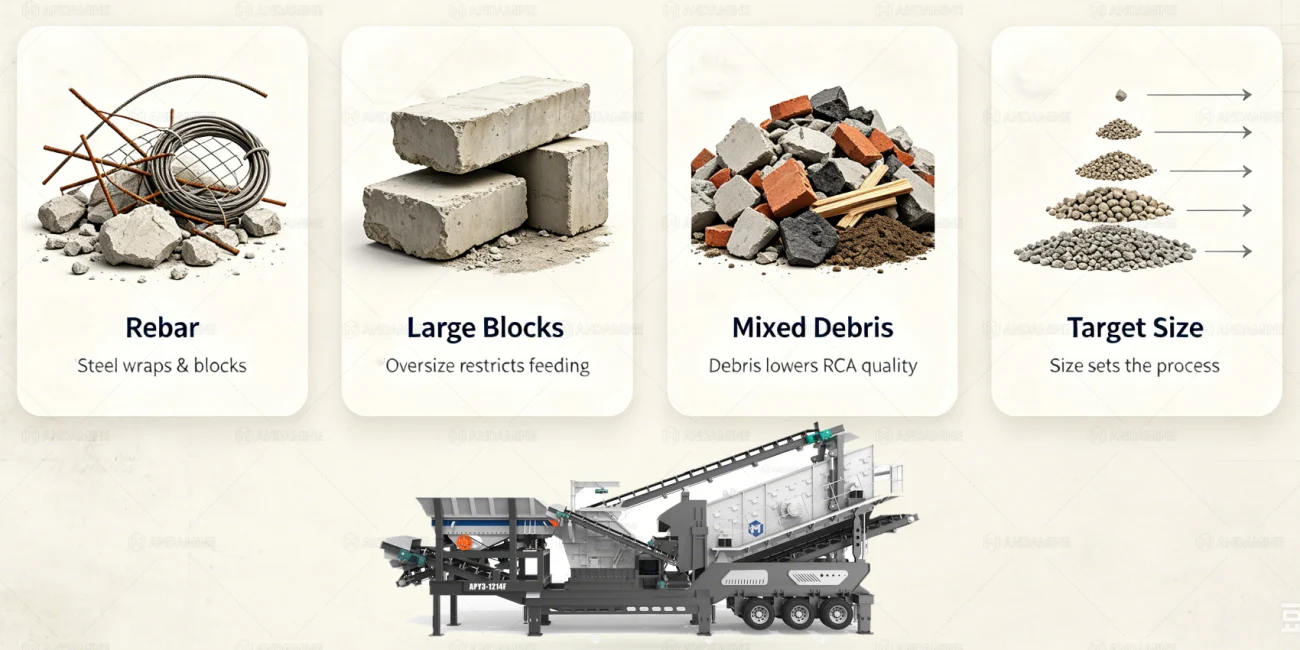
Rebar Can Complicate Concrete Crushing
Rebar and wire mesh can remain embedded in concrete or become exposed as it breaks apart. Long steel pieces may wrap around moving parts or cause blockages, while steel left in the finished aggregate reduces product cleanliness. The amount and condition of reinforcement therefore need to be considered during concrete processing.
Large Concrete Blocks Can Restrict Crusher Feeding
Demolition concrete may arrive as thick slabs, foundation sections, beams, and other irregular pieces. Their physical size and shape can limit how consistently they enter the crusher, even when the overall material volume is manageable. The incoming concrete size must therefore be compatible with the practical feed conditions of the crushing system.
Mixed Debris Can Affect RCA Quality
Demolition concrete may contain bricks, asphalt, soil, wood, or other debris. Crushing alone does not turn mixed demolition material into clean recycled concrete aggregate. The level of contamination affects the consistency and cleanliness of the final RCA and may require additional sorting or separation.
Target RCA Size Determines the Crushing Process
The required aggregate size should be defined before determining the crushing process. A coarse road-base product does not require the same reduction as several controlled aggregate sizes. Crushing beyond the required gradation can create unnecessary fines, wear, and energy consumption without adding value to the final product.
These challenges do not require the same crushing solution for every concrete recycling project. The right equipment configuration depends on the concrete feed, reinforcement, required output, and recycling conditions.
Concrete Crusher Solutions for Different Recycling Requirements
Popular Mobile Solution: Mobile Impact Crusher Plant
Mobile impact crusher plant is widely used when concrete waste needs to be processed close to the demolition or construction site. The configuration can vary between wheeled and tracked equipment.
Wheeled Mobile Impact Crusher: 3-in-1 Solution
A wheeled mobile impact crushing plant can combine feeding, impact crushing, and screening in one integrated unit.
Typical configuration: Feeder + Impact Crusher + Vibrating Screen
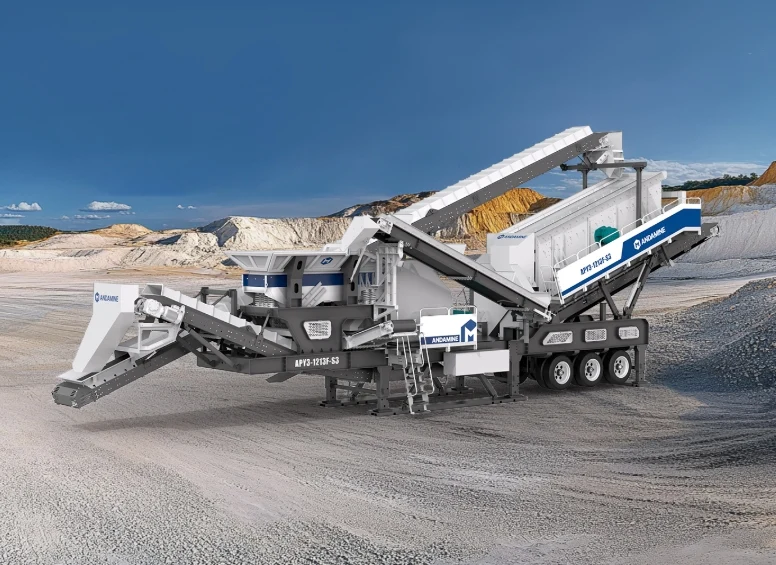
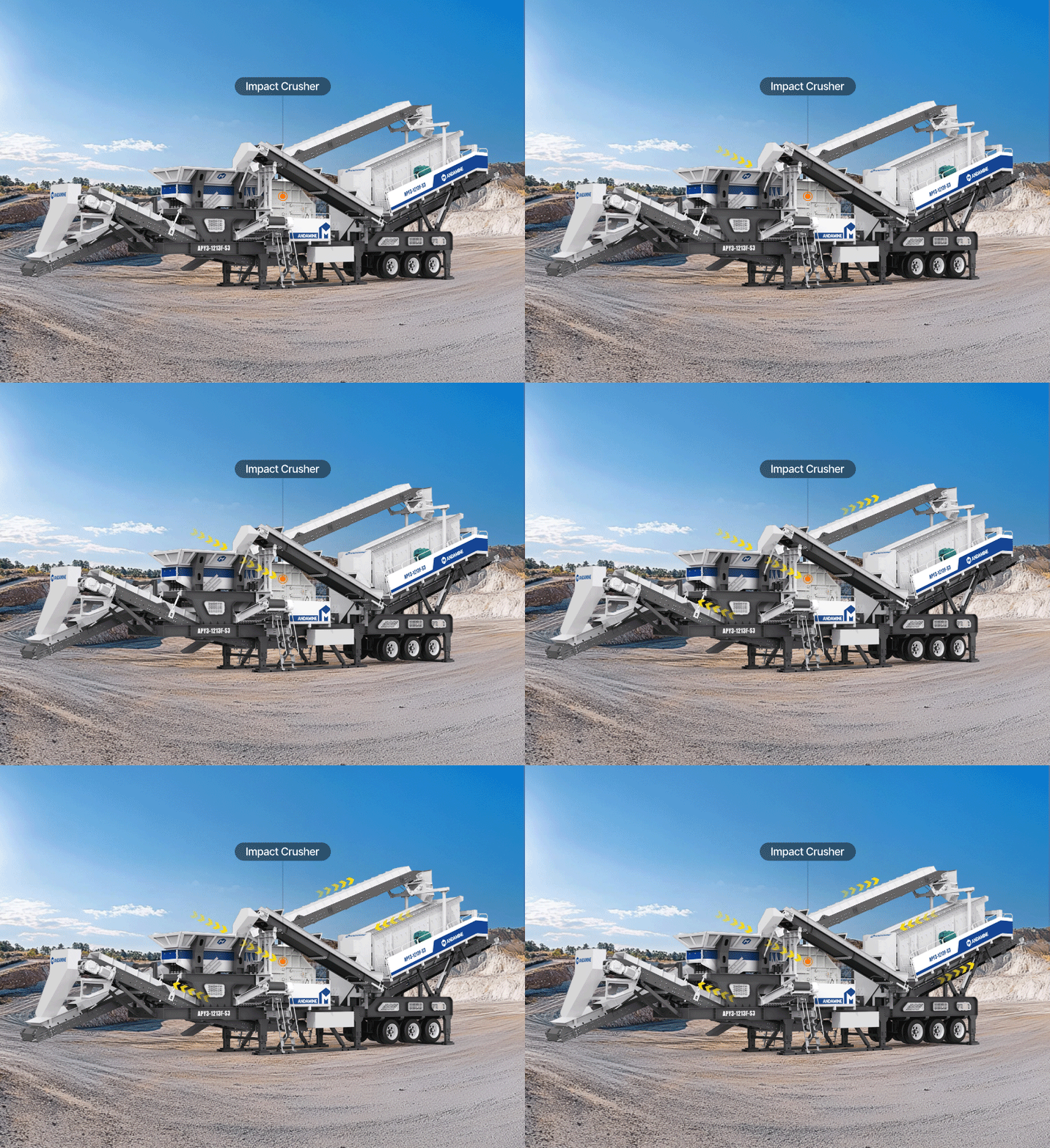
This 3-in-1 setup is suitable for projects that need to crush concrete and produce screened recycled aggregate with a mobile plant.
Main Benefits:
- Get better-shaped recycled aggregate: The heavy-duty impact rotor delivers strong crushing performance and helps produce well-shaped recycled aggregate for reuse.
- Keep material flow under control: Remote-controlled feeding allows operators to adjust feed speed from a distance, supporting smoother and more consistent production.
- Move easily between job sites: The three-axle wheeled chassis makes relocation more convenient when recycling work moves to another suitable site.
- Monitor the plant without staying beside it: IoT remote monitoring provides real-time equipment status and maintenance reminders, helping operators respond to issues earlier.
- Keep dust better controlled: An integrated dust-control solution helps reduce dust during concrete demolition and recycling, supporting a cleaner working environment.
Tracked Mobile Impact Crusher
A tracked impact crusher is a compact mobile crushing solution for projects that need to work directly at demolition or construction sites, especially where ground conditions make wheeled equipment less practical.
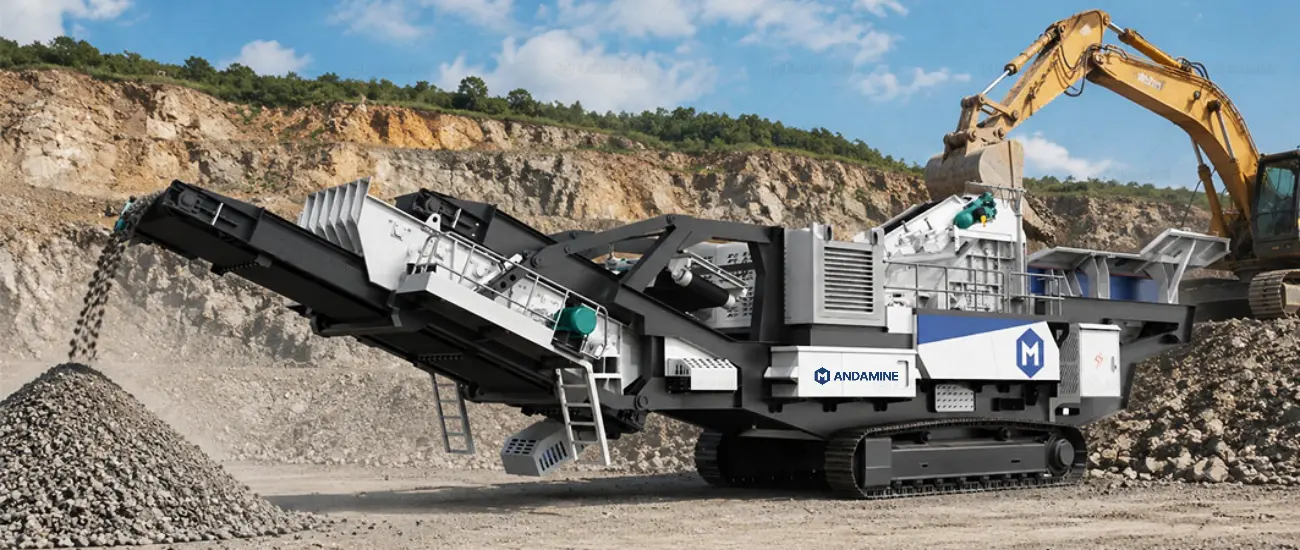
Typical configuration: Feeder + Impact Crusher
Screening is not integrated into the track crusher. When specific recycled aggregate sizes are required, a separate mobile screening plant can be added to create a flexible crushing and screening setup. The tracked chassis allows the crusher to move directly around challenging job sites, making it suitable for demolition areas, construction sites, and other locations with uneven or difficult ground conditions.
Stationary Concrete Crushing Plant: For Long-Term Recycling
A stationary concrete crushing plant is designed for fixed-location recycling operations where concrete waste is continuously delivered to a dedicated processing site. Unlike a compact mobile unit, it can be arranged as a complete processing system based on the required capacity, recycled aggregate sizes, and site layout.
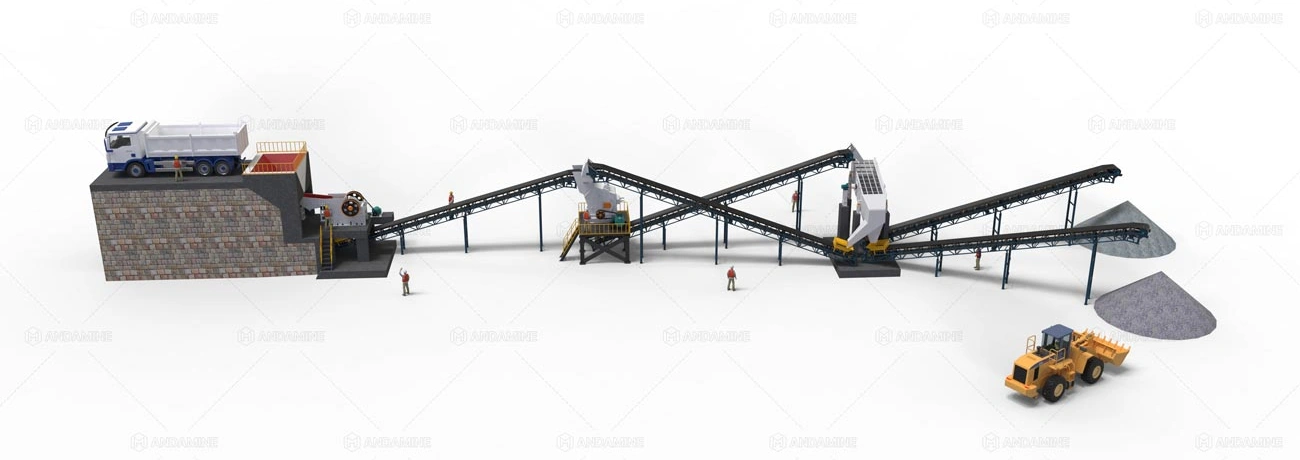
A stationary concrete recycling plant may include:
- Primary and secondary crushing equipment
- Screening equipment
- Magnetic separation for steel removal
- Conveyors and stockpiling conveyors
- Dust-control and supporting systems
The larger layout provides more space for material handling, separation, and stockpiling, making a stationary plant suitable for operations requiring continuous processing, multiple recycled aggregate products, and long-term use at one recycling location.
Real Concrete Crushing Projects: Turning Waste Concrete into Reusable Aggregates
Explore real concrete crushing projects showing how waste concrete is recycled into reusable aggregates for different construction applications.
150TPH Mobile Impact Crusher Recycling Demolition Concrete for Bogotá Metro Project of Colombia
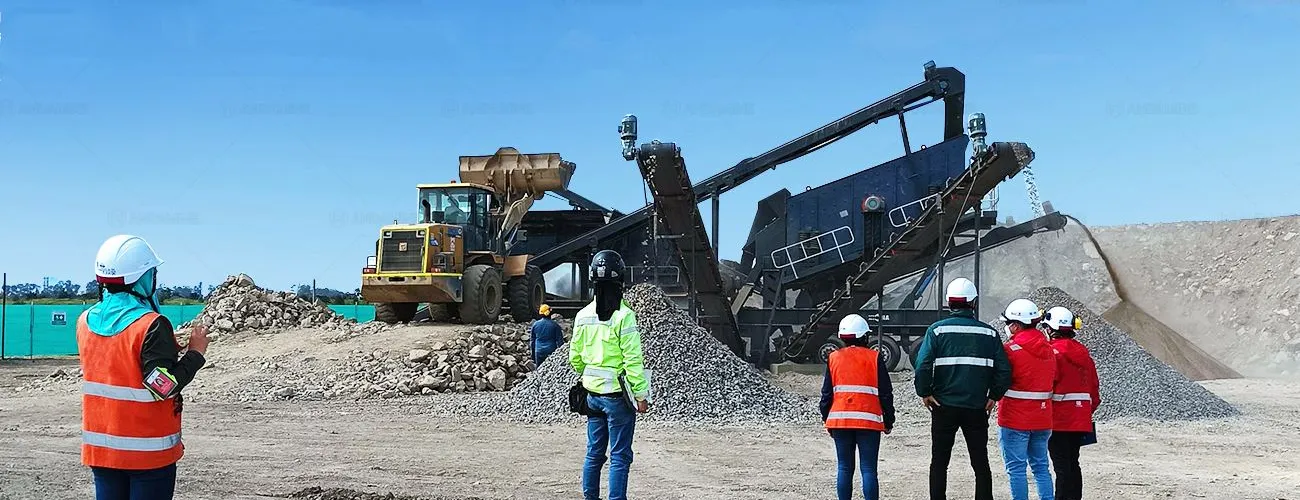
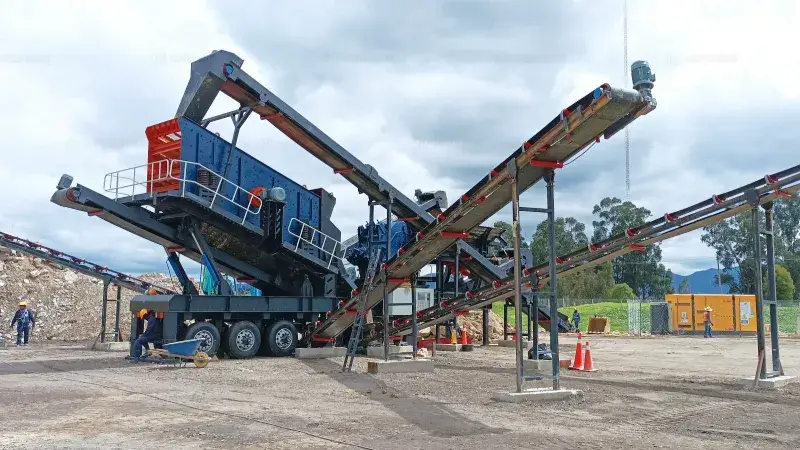
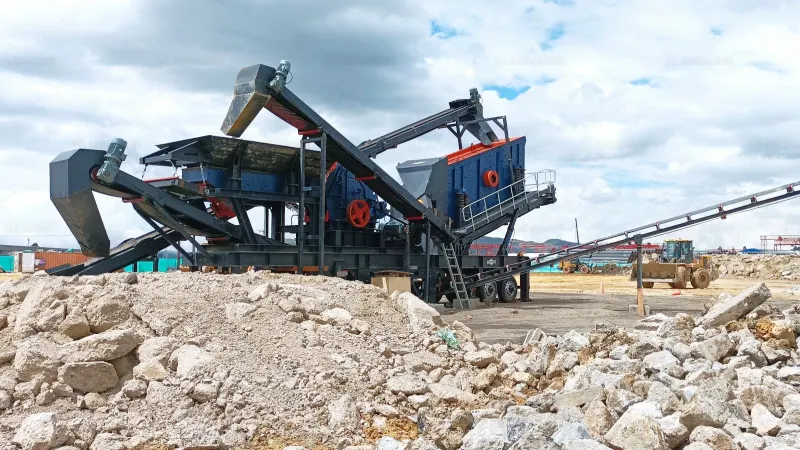
Project Background: Recycling Demolition Concrete for Metro Construction
During the construction of Bogotá Metro Line 1, the contractor needed to process demolition concrete generated from urban construction activities. Instead of transporting large volumes of waste concrete away from the site, the project required an efficient recycling solution that could convert demolition material into reusable sub-base aggregate.
The main challenges were producing aggregates with consistent particle size, good shape, and stable quality while operating in a busy urban construction environment.
Crushing Solution: APY3-F Mobile Impact Crusher for On-Site Recycling
To meet these requirements, an APY3-F wheel-mounted mobile impact crusher was provided for on-site concrete recycling.
The mobile impact crusher allowed the contractor to process demolition concrete close to the project area, reducing the need for long-distance waste transportation. Its impact crushing system helped produce recycled aggregates with suitable particle shape and gradation for sub-base applications.
The integrated mobile design also simplified site deployment, making it suitable for construction projects where space, transportation, and operational flexibility are important factors.
Project Results: Producing Recycled Aggregate for Metro Infrastructure
The mobile crusher successfully transformed demolition concrete into qualified recycled sub-base material for the metro construction project. The solution helped the contractor:
- Reduce concrete waste transportation and disposal costs.
- Recover valuable aggregates from demolition materials.
- Maintain a stable supply of recycled material directly on site.
The project demonstrates how mobile impact crushing technology can help urban construction projects reuse concrete waste instead of treating it as disposable material.
200TPH Mobile Concrete Crusher for sale in the Philippines Supporting Concrete Waste Processing
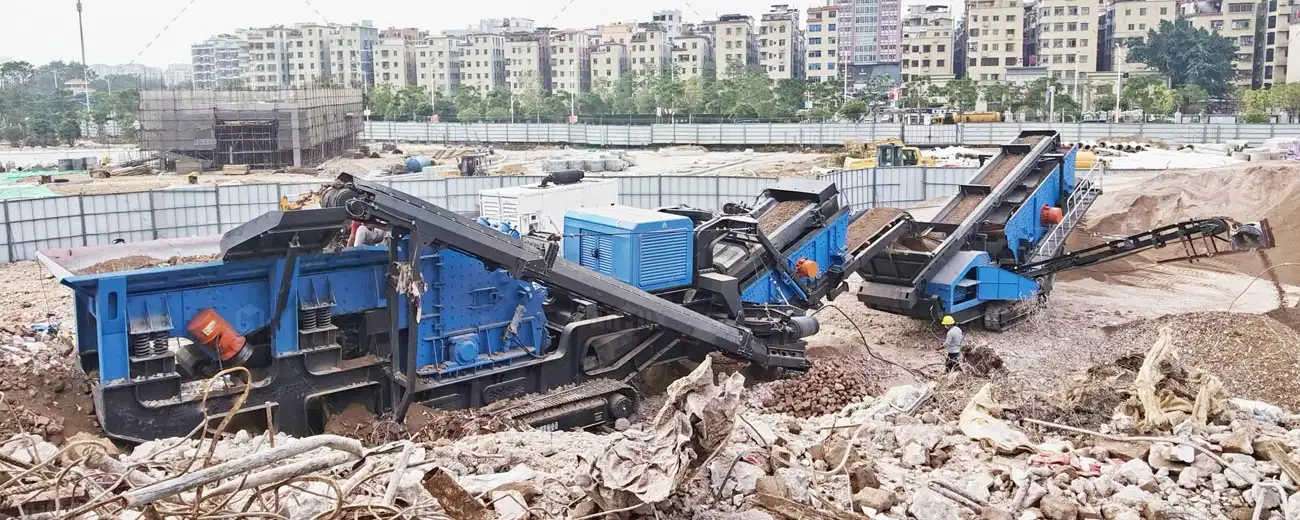
Project Background: Recycling Concrete Waste for Reuse
The project involved processing large amounts of waste concrete, masonry, and cement debris generated from construction activities. Instead of sending these materials to landfill, the customer needed an efficient recycling solution to produce graded aggregates for concrete-related applications.
Crushing Solution: Mobile Impact Crushing and Screening System
A 200TPH track-mounted mobile impact crusher was paired with a tracked mobile screening plant to form a flexible concrete recycling system. The impact crusher handles demolition concrete blocks, red bricks, and cement waste with feed sizes below 400 mm, while the separate mobile screen classifies the crushed material into multiple recycled aggregate sizes, including 0–5 mm, 5–20 mm, and 20–40 mm.
Project Results: Producing Multiple RCA Products
The recycled aggregates are supplied to ready-mix concrete batching plants and used for applications such as permeable paving bricks. The multi-grade screening system helps meet different material requirements, while the mobile crawler design allows flexible operation in confined urban construction areas.
How Does a Concrete Crusher Work?
A concrete crusher system works by processing waste concrete through sorting, crushing, steel separation, and screening stages to produce reusable recycled concrete aggregate (RCA).
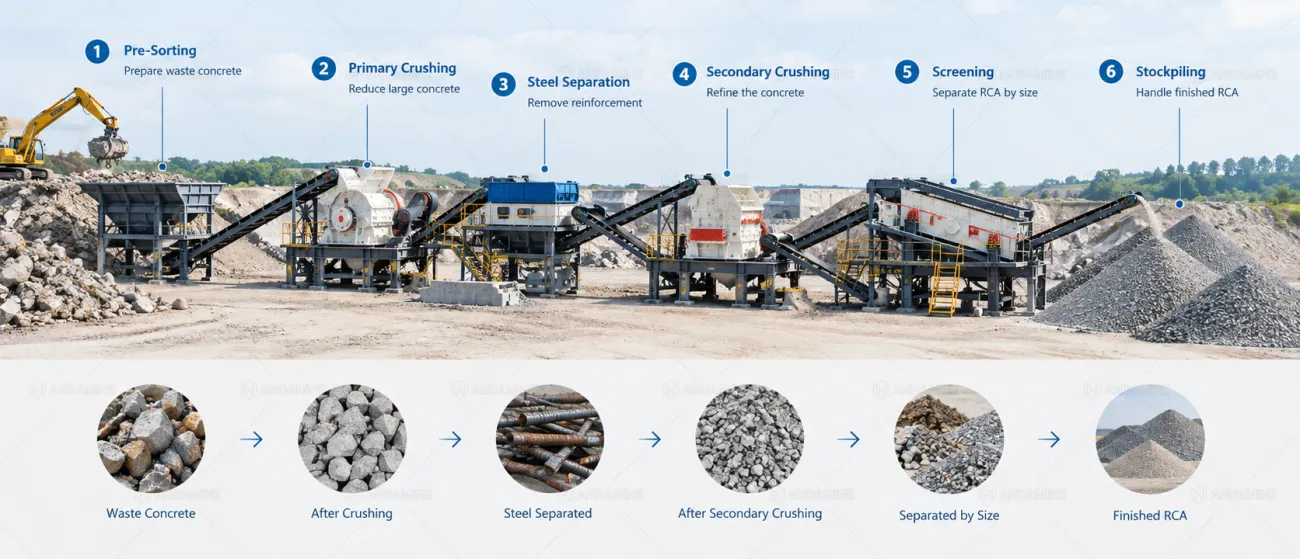
Pre-Sorting: Preparing Waste Concrete
Waste concrete is inspected and prepared before entering the crushing system.
- Remove contaminants: Soil, wood, plastic, and other unwanted materials should be removed where possible.
- Check feed size: Oversized concrete may require preparation before entering the primary crusher.
- Separate obvious steel: Large exposed rebar can be cut or removed before crushing to reduce blockage risks.
Primary Crushing: Reducing Large Concrete
The primary crushing stage breaks large and irregular concrete pieces into a smaller, manageable feed. Jaw crushers are commonly used for this stage when demolition concrete contains large blocks or structural pieces.
The main objective is to reduce the feed size and expose embedded reinforcement so the material can continue through the recycling process.
Steel Separation: Removing Reinforcement
After concrete is broken apart, magnetic separators can remove exposed steel and other ferrous metals from the crushed material.
This step improves the cleanliness of the recycled aggregate and prevents recovered reinforcement from entering later processing stages. The exact position of magnetic separation can vary according to the plant configuration and material flow.
Secondary Crushing: Refining the Concrete
Further crushing reduces the concrete to the particle sizes required for the recycled aggregate product. Impact crushers are often used for secondary reduction because they can further break the material while improving particle shape.
Depending on the required product, the material may pass through additional crushing stages or return to the crusher in a closed circuit.
Screening: Separating RCA by Size
Vibrating screens separate the crushed concrete into different particle-size ranges.
Screening controls the final gradation and allows different RCA products to be separated for their intended uses. Oversized material can be returned for further crushing when the system is designed for closed-circuit operation.
Stockpiling: Handling Finished RCA
After crushing and screening, finished recycled concrete aggregate is conveyed to separate stockpiles according to size and quality requirements.
Keeping different sizes separated helps prevent cross-contamination and maintains consistent material quality until the RCA is transported or used in construction projects.
What Are the Main Applications of Recycled Concrete Aggregates?
The main applications of recycled concrete aggregates (RCA) include road base and sub-base construction, foundation and trench backfilling, site preparation, and selected concrete products. The appropriate use depends on the quality, size, and properties of the recycled aggregate.
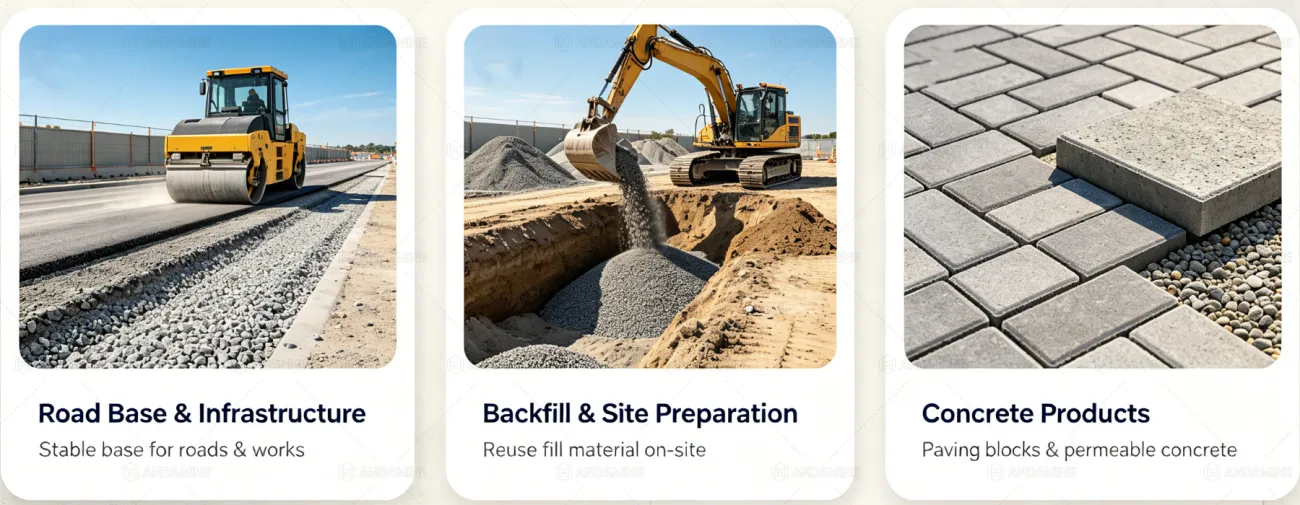
Road Base and Infrastructure Construction
Road base and sub-base materials are among the most common applications for recycled concrete aggregate.
Crushed concrete from demolition projects can be processed into stable granular materials for roads and infrastructure works. For urban construction and renovation projects, producing RCA on-site can also reduce transportation distance and waste disposal costs.
Backfill and Site Preparation
Recycled concrete aggregate is widely used for foundation filling, trench backfilling, and site preparation.
This application is especially suitable for projects that generate large amounts of concrete waste, allowing contractors to reuse the material locally instead of sending it to landfill and purchasing new fill materials.
Concrete Products and Secondary Construction Materials
With proper crushing, screening, and quality control, RCA can be used in selected concrete-related applications.
Processed recycled aggregates can support products such as paving blocks and permeable concrete materials, helping reduce natural aggregate consumption and improve construction sustainability.
Why Concrete Recycling Is Becoming a Long-Term Opportunity
The demand for concrete recycling is increasing as construction industries look for alternatives to traditional disposal and natural aggregate extraction. UNEP estimates that the global construction sector generates around 2 billion tons of construction and demolition waste each year, accounting for approximately one-third of all global waste, while only a small fraction is currently recycled or reused.
Several factors are driving this change:
- Growing construction waste volumes: Urban redevelopment and infrastructure projects continue to generate large amounts of demolition concrete, creating a substantial and recurring feedstock for recycling.
- Rising transportation and disposal costs: Processing concrete near the demolition site can reduce hauling distances, landfill pressure, and overall waste management costs.
- Increasing demand for recycled aggregates: Recycled concrete aggregate (RCA) is increasingly used in road construction, backfilling, and other applications where suitable quality requirements can be achieved.
- More flexible recycling equipment: Mobile concrete crushers allow contractors to process waste concrete directly at project sites, reducing transportation while recovering usable aggregate.
For contractors, demolition companies, and recycling operators, concrete crushing is therefore not only a waste disposal solution but also a way to recover material value from a large and recurring waste stream and build a more sustainable construction supply chain.
How to Choose the Right Concrete Crusher Plant for Your Project?
Choosing a concrete crusher plant depends on more than production capacity. Factors such as concrete type, reinforcement, final aggregate requirements, and project location all influence the most suitable crushing solution.
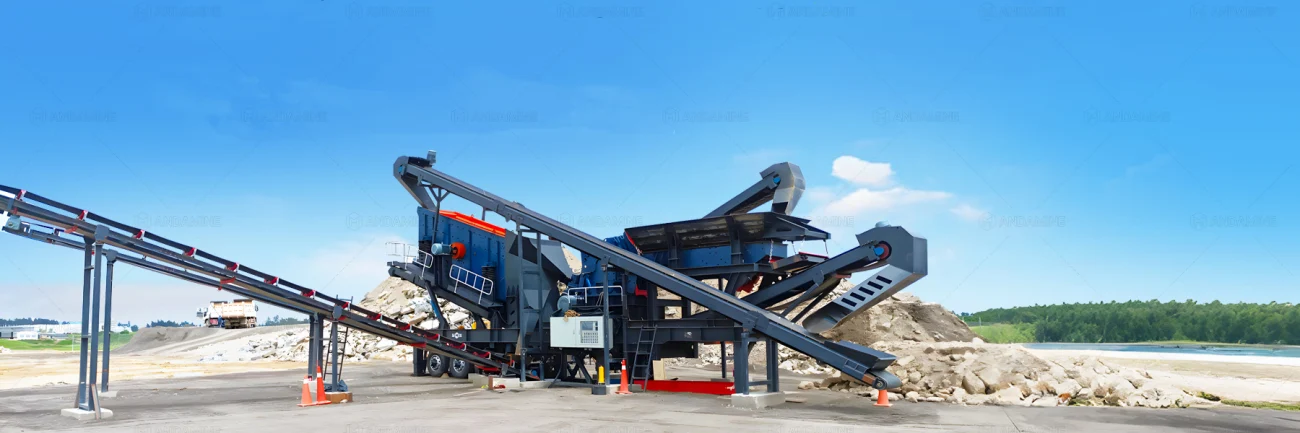
Consider the Type and Condition of Concrete Waste
The characteristics of incoming concrete directly affect crusher selection.
- Large reinforced concrete blocks: Demolition structures with heavy reinforcement usually require strong primary crushing and effective steel separation.
- Clean precast concrete waste: More consistent material may need a simpler crushing process with less pre-treatment.
- Mixed construction waste: Materials containing bricks, asphalt, or other debris require better sorting and processing flexibility.
Consider the Required Recycled Aggregate Quality
The final application determines how the crushing system should be configured.
- Road base and backfill: A simpler crushing and screening process may meet the requirements.
- Concrete products or higher-grade applications: Additional crushing and screening stages may be needed to achieve better particle shape and size control.
- Multiple aggregate sizes: A multi-stage system with screening is preferred when different products are required.
Consider the Project Location and Operating Conditions
The working environment is another important factor for concrete recycling projects.
- Multiple demolition sites or temporary projects: Mobile crushers provide easier relocation and on-site processing.
- Long-term recycling facilities: Stationary crushing plants can offer higher efficiency for centralized operations.
- Limited urban space: Compact mobile concrete crusher solutions can reduce transportation requirements and adapt to restricted working areas.
Maintenance When Crushing Reinforced Concrete
Crushing reinforced concrete creates additional maintenance challenges compared with natural stone processing. Steel reinforcement, abrasive concrete particles, and variable demolition materials can increase wear and create blockage risks if the equipment is not properly maintained.
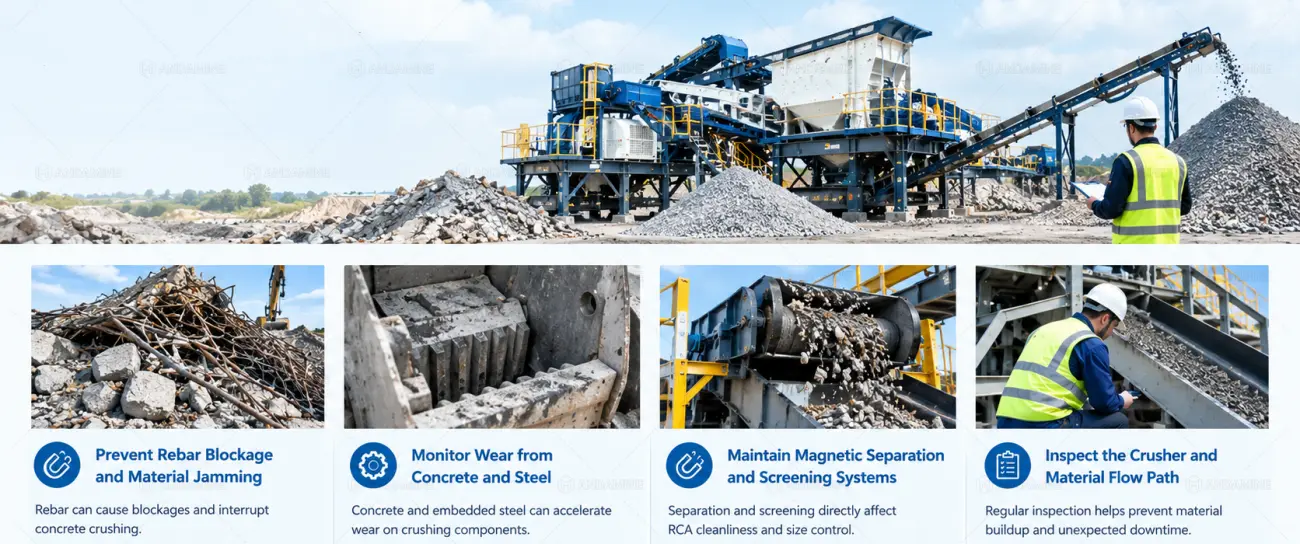
Prevent Rebar Blockage and Material Jamming
Rebar can cause blockages and interrupt concrete crushing.
- Remove excessive steel before crushing: Large exposed rebar should be cut or separated before entering the crusher machine.
- Check discharge areas: Long steel pieces may become tangled or restrict material flow.
- Clear blockages promptly: Stop the equipment and remove trapped steel or oversized material before restarting.
Monitor Wear from Concrete and Steel
Concrete and embedded steel can accelerate wear on crushing components.
- Check wear parts: Inspect jaw plates, impact plates, blow bars, and liners according to material conditions and operating hours.
- Adjust replacement intervals: Highly reinforced or abrasive concrete may require more frequent wear-part replacement.
- Monitor crushing performance: Reduced output or unstable particle size can indicate excessive wear.
Maintain Magnetic Separation and Screening Systems
Separation and screening directly affect RCA cleanliness and size control.
- Clean magnetic separators: Remove accumulated steel to maintain separation efficiency.
- Inspect vibrating screens: Check for damaged screens or blocked openings.
- Check final product quality: Changes in cleanliness or gradation may indicate separation or screening problems.
Inspect the Crusher and Material Flow Path
Regular inspection helps prevent material buildup and unexpected downtime.
- Check for concrete buildup: Hardened material can restrict flow and reduce efficiency.
- Inspect material flow paths: Check chutes, discharge openings, and transfer points for accumulated material.
- Follow planned inspections: Mobile crushers need regular checks when operating across multiple demolition sites.
Concrete Crusher FAQs
What Is a Concrete Crusher?
What size concrete can a crusher process?
Can crushed concrete be reused as aggregate?
Is a mobile concrete crushing plant better than a stationary plant?
How much does a concrete crusher cost?
What is the best crusher for recycling demolition concrete?
Choosing the right concrete crusher starts with understanding your waste material, required output, and operating conditions. As a concrete crusher manufacturer, Andamine provides customized crushing solutions for on-site recycling and long-term aggregate production, helping match the equipment configuration to your application. Contact us to discuss your project needs.