Urban construction waste is no longer an occasional byproduct of development. As cities shift toward redevelopment, demolition and reconstruction activities are generating increasingly large volumes of materials that require faster and more efficient handling. In this context, mobile crushing plants are emerging as a practical approach by bringing processing and resource recovery closer to the source of waste generation, reshaping how construction waste is managed in modern urban projects.
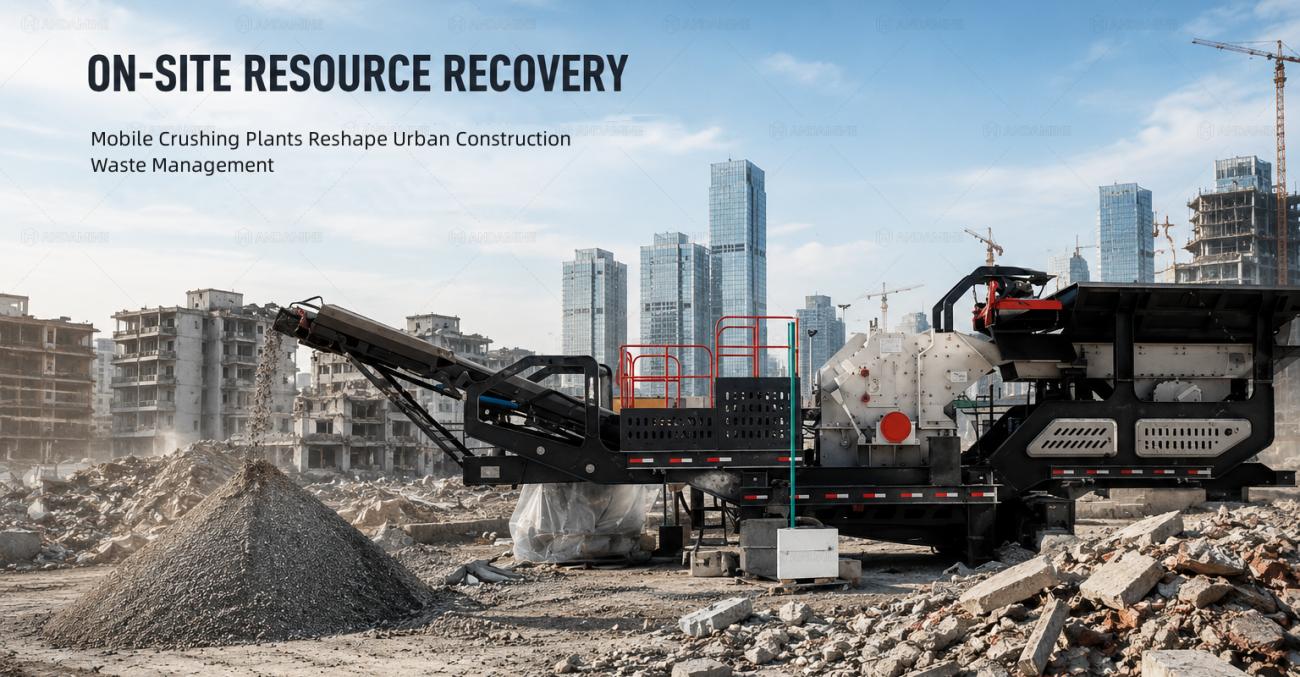
Why Urban Construction Waste Management Is Changing
Urban construction waste management is changing as demolition and redevelopment projects become more frequent in modern cities. Unlike earlier times when waste appeared in separate and limited events, today it is generated in a steady and continuous way. This puts more pressure on how materials are collected, transported, and processed efficiently, especially when speed and on-site handling become critical factors.
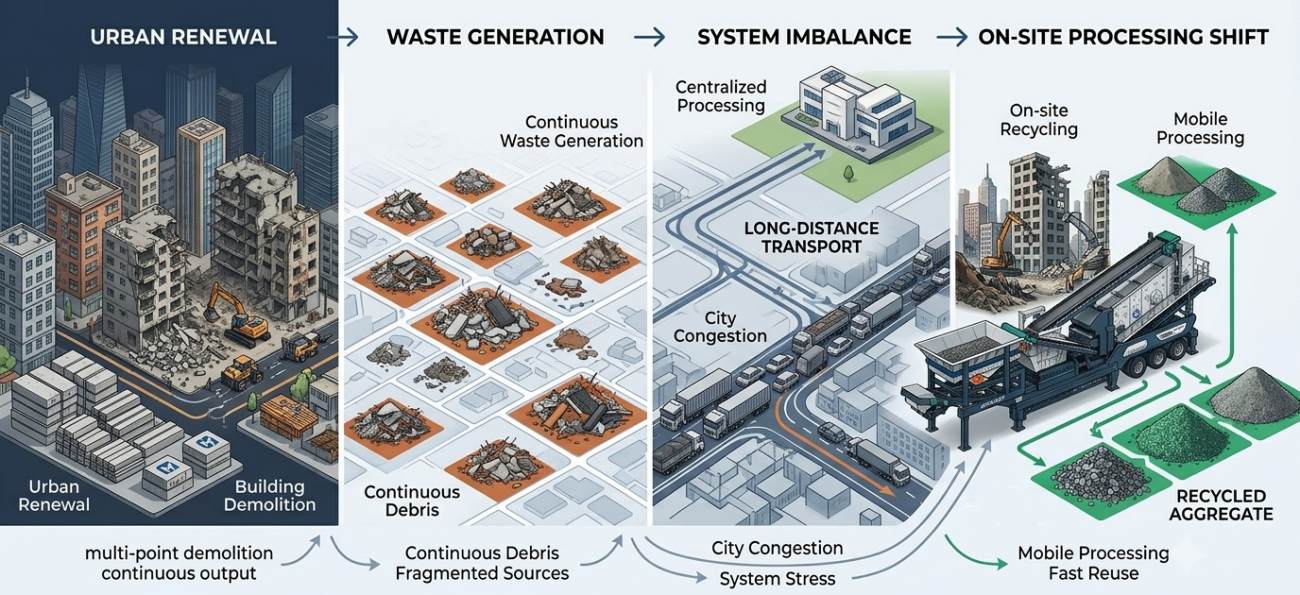
Urban Development Is Driven by Renewal
Modern cities are growing mainly through renewal rather than expansion. Large numbers of old residential, commercial, and industrial buildings are being demolished and rebuilt.
This results in more frequent but smaller-scale demolition projects spread across different urban areas. Construction waste is therefore no longer concentrated in one place but generated continuously across the city.
Limits of Traditional Waste Handling Systems
The traditional model relies on transporting waste from demolition sites to centralized processing facilities. These facilities are usually located outside urban areas.
This creates a clear separation between waste generation and processing, leading to long transportation distances, multiple handling steps, and increasing pressure on logistics in dense urban environments.
The Gap Between Waste Generation and Processing Capacity
Construction waste is now generated in many scattered locations, while recycling facilities remain limited and centralized. This imbalance creates inefficiencies in collection and transportation.
As cities become denser, transportation constraints such as traffic congestion and access restrictions further reduce the efficiency of the traditional system.
Moving Toward On-Site Processing
To address these challenges, the industry is shifting toward processing materials closer to where they are generated. This reduces unnecessary transportation and shortens the overall handling chain.
Mobile crushing plants make this possible by allowing waste processing to be carried out directly at demolition sites, improving efficiency and enabling faster material reuse.
How Urban Construction Waste Is Evolving
Urban construction waste is changing not only in quantity, but also in how it is generated, composed, and managed. These changes are gradually making traditional handling methods less efficient, especially in dense urban environments.
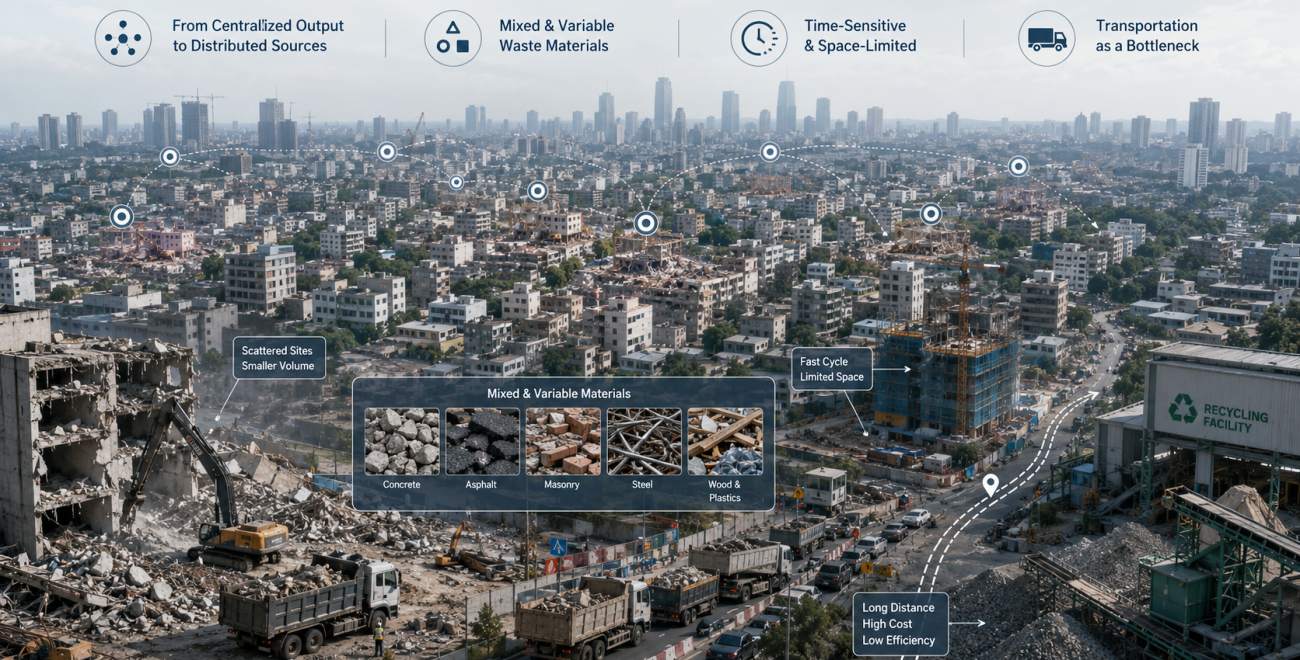
From Large Projects to Distributed Small Sites
One of the most noticeable changes in urban construction is the shift from large, centralized demolition projects to smaller and more widely distributed sites. Instead of a few major redevelopment zones, cities now experience continuous renewal across residential neighborhoods, commercial areas, and aging infrastructure corridors.
The key change is not the size of each project, but their distribution pattern.
In practice, this leads to three important characteristics:
- Demolition activities are more frequent but scattered across different districts.
- Each site produces a relatively smaller volume of waste, but the overall city-wide output remains high.
- Waste management must now deal with multiple sources operating at the same time rather than one centralized stream.
👉 Construction waste has shifted from a “centralized output” to a “distributed network of sources”.
Increasing Complexity of Waste Materials
At the same time, the composition of construction waste has become more complex. Modern demolition projects rarely produce a single type of material. Instead, they generate mixed waste streams that combine different structural and non-structural elements.
Typical materials include reinforced concrete, asphalt, masonry, steel components, and various light construction residues such as wood and plastics.
The challenge is not only the variety, but also the inconsistency between projects. Buildings constructed in different periods or under different standards often produce waste with very different physical characteristics.
👉 Construction waste is no longer uniform—it is a mixed and variable material system that requires flexible processing rather than standardized handling.
Faster Construction Cycles and Limited On-Site Space
Urban construction projects are also becoming faster and more space-constrained. In redevelopment areas, both demolition and reconstruction phases are often compressed into shorter timelines to accelerate land reuse and urban renewal.
At the same time, construction sites in cities usually have very limited space. This creates a practical constraint that directly affects waste handling:
- Waste materials cannot be stored on-site for long periods.
- Continuous accumulation quickly interferes with construction activities.
- Site logistics must prioritize fast clearance or immediate processing.
👉 Construction waste is no longer something that can be temporarily stored—it has become a time-sensitive operational factor in project execution.
Transportation Is Becoming a Structural Constraint
As waste becomes more dispersed and project timelines become tighter, transportation is increasingly acting as a system-level constraint rather than just an operational task.
In urban environments, several factors combine to create this pressure:
- Traffic congestion reduces hauling efficiency and increases unpredictability in delivery times.
- Transportation costs continue to rise due to fuel, labor, and regulatory requirements.
- Access to centralized disposal or recycling facilities is often limited, especially in large cities.
What makes this more significant is that these issues reinforce each other. The more fragmented the waste sources become, the more dependent the system is on long-distance transportation—and the less efficient it becomes overall.
👉 Transportation is no longer just a cost factor, but a bottleneck that limits the entire waste management system.
Mobile Crushing Plants as a New Processing Approach
Mobile crushing plants introduce a shift in construction waste management by moving processing activities closer to demolition and construction sites. This changes the traditional model where all waste must be transported to centralized facilities before treatment.
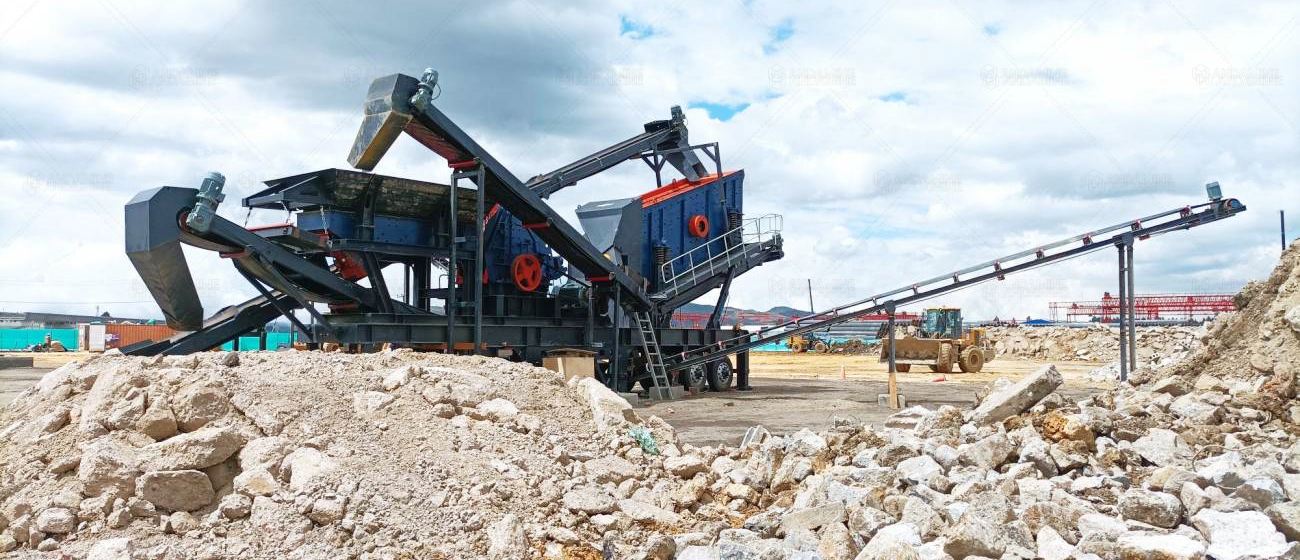
From Fixed Plants to Mobile Processing Units
The most fundamental change is the relocation of crushing operations from fixed facilities to mobile, site-based units.
Traditional crushing equipment is installed in permanent recycling plants. In this system, construction waste must be transported away from demolition sites before any processing can begin. This makes transportation a mandatory step in the workflow. Mobile crusher plants remove this restriction. The equipment can be deployed directly to job sites, allowing crushing operations to start immediately where waste is generated.
This creates a clear structural difference:
- Stationary crushing systems depend on centralized infrastructure.
- Mobile crushing systems depend on on-site deployment capability.
As a result, processing is no longer limited by location, but becomes available wherever construction activity occurs.
Processing Waste at the Source
The key advantage of mobile crushing is the ability to process construction waste at or near the point of generation.
Instead of transporting materials to distant recycling facilities before treatment, crushing operations can begin directly at demolition or construction sites. This brings processing capacity closer to where waste is generated and strengthens the connection between demolition activities and resource recovery.
This leads to three practical changes:
- Materials can be processed immediately after demolition, reducing the time gap between waste generation and reuse preparation.
- Recovered materials remain closer to potential reuse locations, improving their usability within nearby projects.
- Waste handling becomes more localized, reducing dependence on long external processing chains.
The overall effect is a more direct material flow from demolition to reuse.
Flexible Deployment for Different Construction Conditions
Urban construction projects vary widely in scale and environment, and this variability requires a processing system that is not fixed to one location. Mobile crusher plants are designed to match this requirement through flexible deployment.
They can be adapted in three main ways:
- Project scale adaptation: smaller sites can operate with a single unit, while larger infrastructure projects may require multiple units working together.
- Site mobility: equipment can be relocated as one project ends and another begins.
- Urban environment adaptation: suitable for constrained spaces where permanent facilities are not practical.
This flexibility allows processing capacity to follow construction demand rather than being restricted by permanent infrastructure placement.
Why Mobility Matters in Modern Cities
The importance of mobility becomes clear as construction activities become more distributed across urban areas.
Urban renewal projects, infrastructure upgrades, and redevelopment activities often take place simultaneously at different locations. As a result, construction waste is generated across multiple scattered sites rather than in a single concentrated area.
Mobile crushing plants address this challenge by allowing processing capacity to move with construction demand. Instead of being fixed in one location, crushing operations can be deployed closer to active project sites and adjusted according to changing jobsite conditions.
This makes mobile crushing a practical solution for supporting modern urban construction and demolition environments, where flexibility and on-site adaptability are increasingly important.
How On-Site Resource Recovery Works
On-site resource recovery converts construction waste into usable materials directly at or near demolition sites. Instead of relying on external recycling facilities, the process is completed within a localized workflow that supports faster material reuse within the same project environment.
01Primary Crushing of Construction Waste
The first step is reducing demolition waste into manageable material sizes.
After demolition, materials such as concrete blocks and masonry are typically too large and irregular for direct reuse. Primary crushing breaks them into smaller, more uniform fragments, creating a stable base for further processing.
This step is essential because it transforms demolition debris into a material form that can enter the recycling system.
02Steel Separation and Metal Recovery
The next step is separating embedded steel from crushed concrete materials.
In reinforced structures, steel is tightly bonded with concrete. During crushing, this connection is released, allowing magnetic systems to recover metal components.
This process serves two key purposes: recovering reusable steel materials and ensuring the quality of final aggregate products by removing metal contamination.
03Screening and Cleaning Processes
After crushing and metal separation, the material is screened to remove impurities and fine particles.
Unwanted elements such as wood, plastic, soil, and dust are removed through mechanical or air separation systems. This step ensures that the final recycled material maintains consistent quality for engineering use.
04Producing Reusable Construction Materials
Once processed, the materials are classified into different grades of reusable construction products.
High-quality recycled aggregates are typically used in road bases and infrastructure foundations, while lower-grade materials are used for backfilling and general construction support.
This process transforms construction waste into multiple usable material streams rather than a single disposal output.
The core principle of on-site resource recovery is processing and reusing materials where they are generated. By turning construction waste into reusable aggregates directly at or near demolition sites, the system reduces transportation, shortens processing time, and supports faster material reuse within the same project environment.
How On-Site Processing Changes Construction Workflows
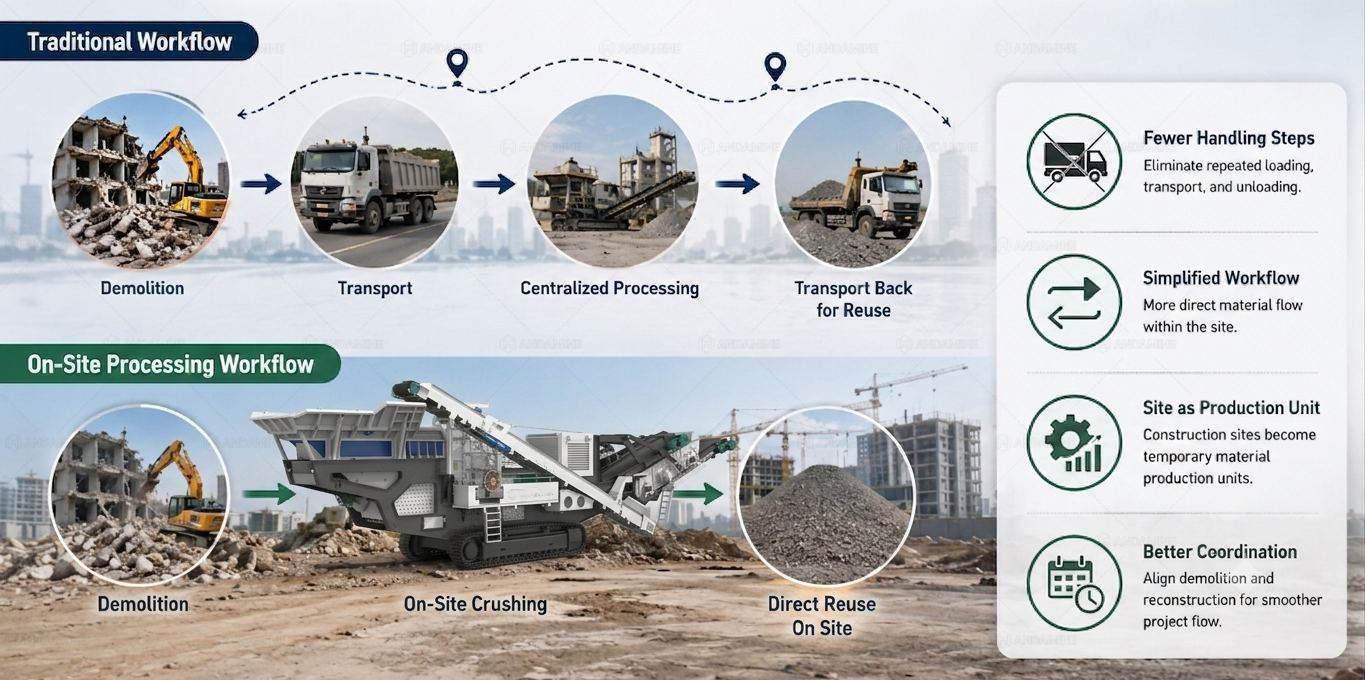
Traditional construction waste management typically follows a multi-stage process in which demolition waste is transported to external recycling facilities before being processed and shipped back for reuse. This approach involves repeated loading, hauling, unloading, and coordination between different locations, increasing both material movement and workflow complexity.
By contrast, on-site processing integrates crushing and recycling directly into the construction environment. It simplifies the overall workflow by reducing external dependencies and allowing recovered materials to be reused much closer to where they are generated.
Localized Material Processing
On-site processing removes the need for long-distance transportation in the early stages of waste management and creates a more localized operational model.
The workflow becomes:
- Demolition generates waste materials.
- On-site crushing processes materials immediately.
- Recycled materials are reused directly within or near the project site.
This creates a localized system where processing and reuse occur within the same operational environment.
Reduced Material Handling
One of the key improvements of on-site processing is the reduction of intermediate handling operations.
By eliminating repeated loading, transport, and unloading stages, material movement becomes more direct and less fragmented.
This results in:
- Fewer handling operations across the project lifecycle.
- Smoother internal material movement within the site.
- More continuous construction progress with fewer interruptions.
The main improvement is structural simplification rather than simply increasing operational speed.
Integrated Material Production
With on-site processing, construction sites take on a dual role. They are no longer only locations where waste is generated but also temporary production units for recycled materials.
This integration allows demolition waste to be converted into reusable aggregates within the same project environment, making the site an active part of the material supply chain and reducing reliance on external recycling facilities.
Better Demolition–Reconstruction Coordination
On-site processing improves coordination between project phases by aligning material availability with construction timing. Since materials can be processed immediately after demolition, the gap between site clearance and reconstruction is reduced.
This leads to:
- More aligned scheduling between demolition and rebuilding.
- Reduced idle time between project stages.
- Smoother transition across construction phases.
The key improvement is better integration of material processing into the overall construction sequence.
Economic Logic of On-Site Resource Recovery
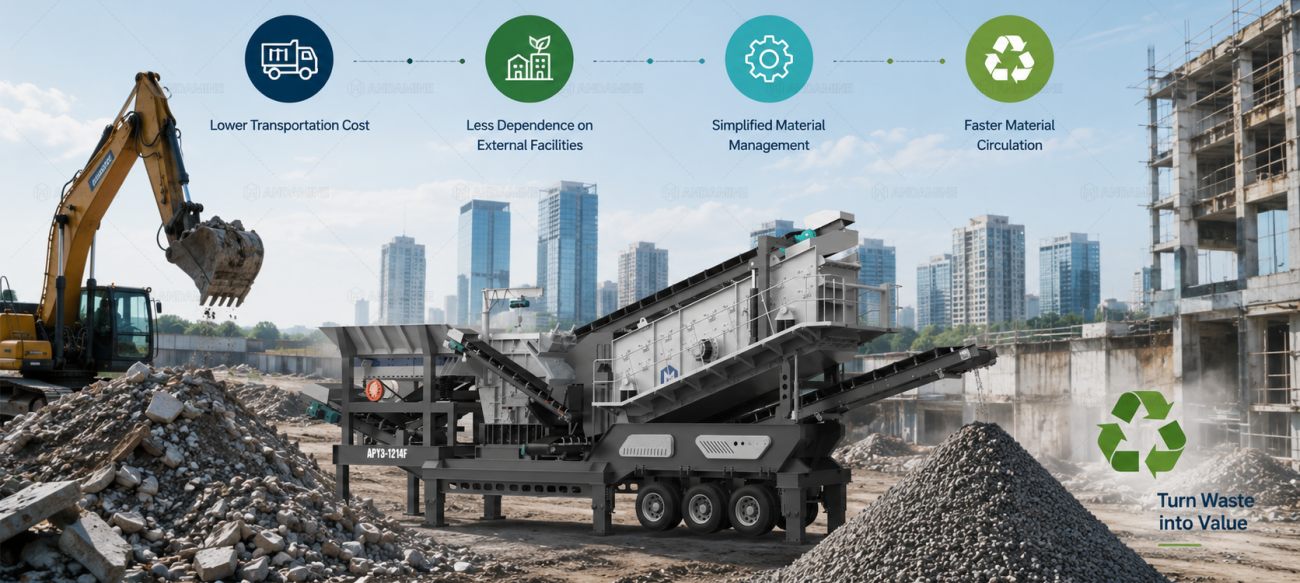
On-site resource recovery reshapes the economic structure of construction waste management by reducing unnecessary material movement, lowering dependency on external processing systems, and improving overall resource utilization efficiency throughout the project lifecycle.
Transportation Cost as a Primary Cost Driver
Transportation costs in construction waste management are not determined by a single movement but by repeated handling cycles throughout the entire process.
Each batch of material typically undergoes multiple operations, including loading, hauling, unloading, and repositioning. These repeated activities significantly increase equipment usage, labor input, and coordination complexity.
In urban construction environments, factors such as traffic congestion, limited site access, and scheduling delays further reduce transport efficiency and increase overall operational uncertainty.
👉 The main cost pressure comes from repeated handling cycles rather than transport distance alone.
Reduced Dependence on External Processing Systems
On-site processing reduces reliance on centralized recycling facilities by integrating part of the material preparation process directly into the construction site.
Instead of transporting all materials to external crushing plants, a portion of crushing and preliminary processing is completed locally. This reduces transportation volume and lowers dependence on external facility capacity and scheduling systems.
It also simplifies coordination with third-party operators and reduces indirect management complexity across the project.
👉 The economic benefit comes from internalizing part of the processing chain within the project boundary.
Streamlined Material Management System
Economic efficiency is further improved through the simplification of the overall material handling system.
Traditional workflows involve multiple independent stakeholders, including demolition teams, transport operators, and external processing plants. This multi-party structure increases coordination complexity and creates delays between operational stages.
On-site processing reduces these interfaces by integrating material handling into a single operational system. As a result, material flow becomes more continuous, predictable, and less dependent on external scheduling.
👉 The key improvement is reduced system complexity and improved operational integration.
Accelerated Internal Material Circulation
When materials remain within the project boundary, the circulation cycle becomes shorter, faster, and more controllable.
Materials can move directly from demolition to processing and reuse without leaving the site environment. This significantly reduces idle time between stages and minimizes temporary storage requirements.
It also improves alignment between material availability and construction progress, enabling smoother coordination between demolition and reconstruction activities.
👉 The final economic outcome is faster and more efficient internal material flow within the project system.
Key Application Scenarios for Mobile Crusher Plants
Mobile crusher plants are most effective in projects where large volumes of construction waste are generated on-site and material handling must be completed within limited space or time conditions. Their value varies depending on project type and operational constraints.
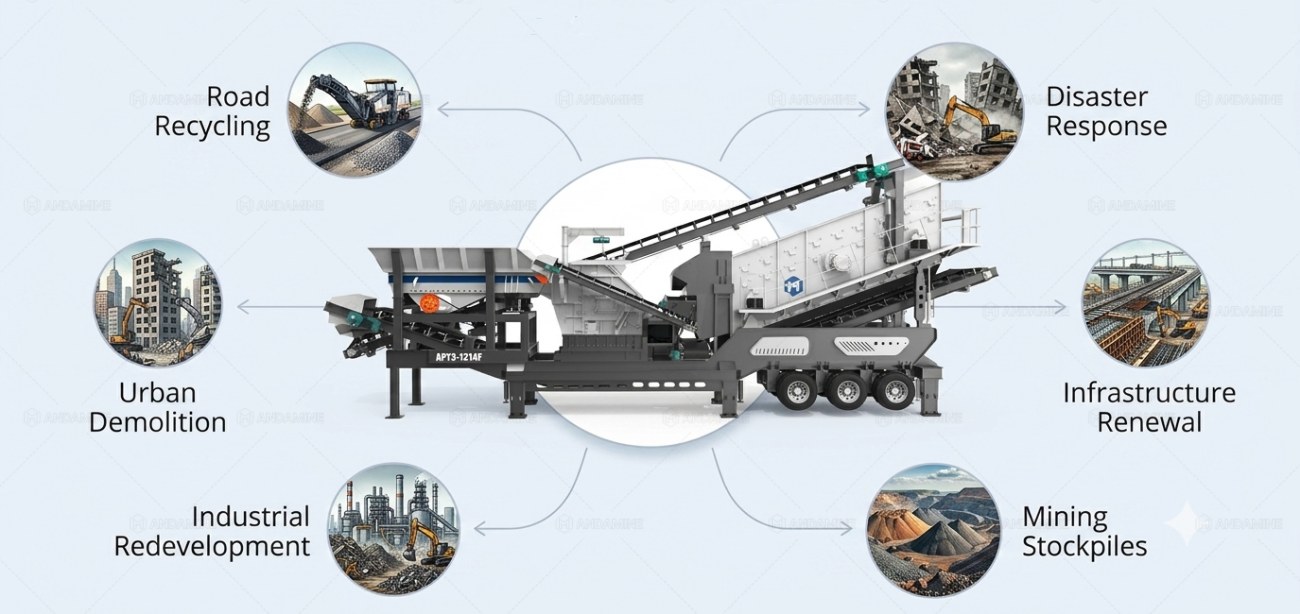
Road Rehabilitation and Asphalt Recycling
Road projects focus mainly on material reuse efficiency within linear infrastructure systems.
Existing asphalt and base layers can be processed and reused as recycled aggregates for new pavement construction. This makes mobile crushing particularly suitable for road upgrading, widening, and resurfacing projects where maintaining continuous traffic flow is important.
👉 The main value is the direct reuse of existing pavement materials within the same infrastructure corridor.
Residential and Commercial Demolition Projects
Urban demolition projects are characterized by space limitations and high-density waste generation.
Buildings in cities produce mixed construction waste within confined environments, making on-site processing a practical solution. Mobile crushing allows materials to be handled within the demolition zone, reducing site congestion and improving coordination with surrounding urban activities.
👉 The key factor here is managing large waste volumes within restricted urban space.
Industrial Site Redevelopment
Industrial projects typically involve heavy reinforced structures and long-term inactive materials.
Old factories and industrial facilities generate dense concrete structures that require strong processing capability at the source. Mobile crushing enables immediate size reduction of reinforced materials, supporting redevelopment without relying on external processing facilities.
👉 The main value is handling high-strength structural waste directly at the demolition site.
Mining Waste and Stockpile Processing
Mining applications focus on reusing existing material stockpiles rather than demolition waste.
Previously extracted but unused materials can be reprocessed into usable aggregate sizes through mobile crushing systems. This improves resource utilization by converting stockpiled waste into construction-ready materials without building permanent processing infrastructure.
👉 The key point is upgrading existing material stockpiles into usable resources.
Infrastructure Renewal Projects
Infrastructure projects require stable processing under operational constraints.
Bridge, railway, port, and airport reconstruction projects often take place in active service environments where disruption must be minimized. Mobile crushing supports these projects by allowing controlled on-site material handling within limited operational space.
👉 The main requirement is maintaining construction activity under strict operational conditions.
Emergency and Disaster Debris Management
Emergency scenarios prioritize rapid site clearance and immediate material reduction.
After disasters, large volumes of debris can block access and delay recovery work. Mobile crushing equipment can be quickly deployed to reduce material size on-site, helping restore basic site accessibility and support early-stage reconstruction.
👉 The key value is fast deployment and immediate debris reduction capability.
The Future of Construction Waste Recycling Systems
The Shift Away from Centralized SystemsCentralized recycling systems are becoming less suitable for modern urban construction environments. Long-distance transportation and dependence on fixed facilities reduce flexibility in project execution. Urban congestion and dispersed construction sites further limit system efficiency, making centralized models less adaptable to current construction patterns.
Rise of Distributed and Mobile ProcessingProcessing is gradually moving closer to construction sites through mobile and distributed systems. This reduces reliance on a single centralized processing center and allows waste to be handled closer to where it is generated. As a result, the system is becoming more location-based rather than facility-based.
Hybrid Structure of Mobile and Fixed SystemsThe future system is not a replacement but a combination of both approaches. Mobile plants handle on-site processing, while fixed facilities focus on large-scale and deeper material treatment. This hybrid model is becoming the practical direction of industry development.
Construction waste recycling is evolving toward a distributed, mobile-driven, and hybrid system that improves efficiency and flexibility in material recovery.
Conclusion: A Shift Toward Circular Construction Waste Systems
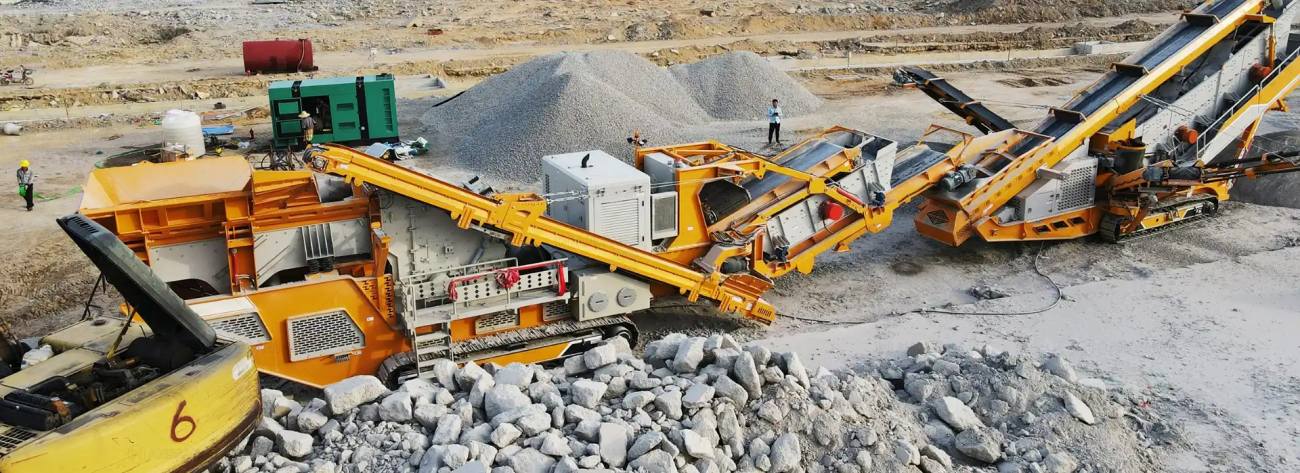
Cities are gradually moving from traditional disposal-based approaches toward circular systems where construction materials are recovered and reused within continuous project cycles. This shift reflects a broader change in urban development, where waste is increasingly treated as a recoverable resource rather than a final output.
Mobile crushing plants support this transition by enabling on-site processing and making material reuse more immediate within construction environments. This helps shorten material recovery cycles and improves how construction waste is reintegrated into new projects.