
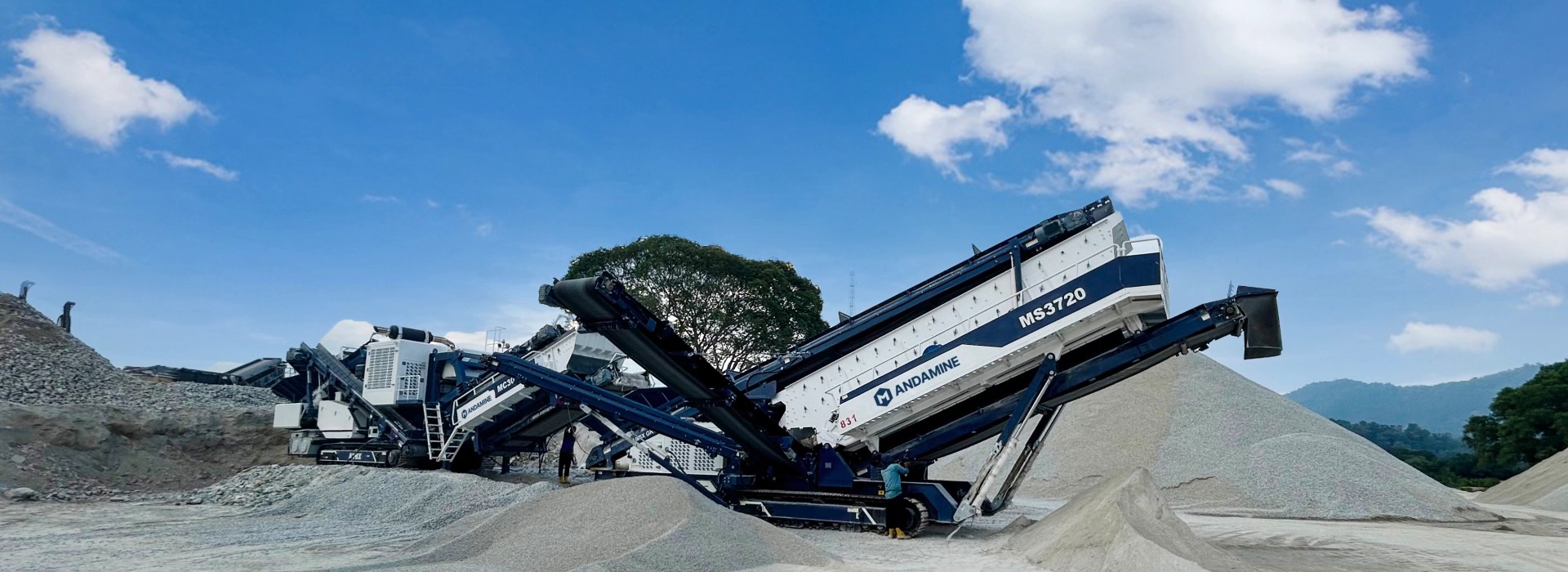

About 40% of the construction waste generated globally each year is waste concrete. How to deal with these billions of tons of waste concrete? The traditional landfill method not only occupies land and incurs high transportation costs, but also causes environmental pollution. Using concrete crushers to crush and screen waste concrete can transform it into recycled aggregates of different particle sizes, which is both economical and environmentally friendly. Andamine offers professional concrete crushing and recycling solutions to help the construction industry transition to a circular economy.

What is A Concrete Crusher?
A concrete crusher is a type of heavy-duty mechanical equipment designed to dispose of concrete waste by breaking down large pieces of hard material into recyclable aggregates through mechanical forces (e.g., crushing, impacting, shearing). It typically consists of a variety of crushing equipment and ancillary facilities to perform crushing operations at construction and demolition sites or other locations where large quantities of concrete waste need to be disposed of.

The concrete crusher machine is designed to break large chunks of waste concrete, construction debris and other hard materials into smaller particles that can be reused or more easily transported and disposed of. It is available in mobile and stationary versions. The mobile concrete crusher is equipped with tire or crawler chassis and can handle up to 40-500 TPH. While the stationary type is suitable for large-scale production lines with a capacity of up to 1000 TPH.
Various Applications of Crushed Concrete
Untreated concrete blocks occupy significant space, incur high transportation costs, and cannot be directly utilised. Specialised concrete recycling crusher employs mechanical force to break down large concrete masses into recycled aggregates of specified dimensions. Crushed concrete aggregate has been widely used in 20+ fields, forming a circular economy market worth more than $5 billion:

Roadbed Materials:
Improves the structural stability of pavements, with 30% of U.S. interstate highways using recycled aggregates.
Concrete products:
Can be used to prepare recycled concrete or mortar, reducing the need for natural sand and gravel extraction.
Foundation backfill:
As a foundation material, the cost is reduced by 35% compared to natural sand and gravel.
Heavy metal curing:
adsorption of lead, cadmium and other heavy metal ions, polluted soil remediation costs reduced by 60%.
Flood control project:
used in water conservancy projects such as slope protection and embankment, enhancing the anti-scouring ability.
Industrial raw materials:
after further grinding, it can be used to produce cement or as metallurgical auxiliary materials.
Landscaping:
crushed concrete blocks can be used for paving walkways or decorative walls, which is both functional and aesthetically pleasing.
Railway Ballast:
Used as railway track ballast, providing stable support and drainage for train operations.
According to research, each ton of recycled aggregate can reduce 1.5 tons of carbon dioxide emissions, with significant environmental benefits.
How Does A Concrete Crusher Work?
The working principle of the concrete crusher for sale is mainly to crush the large concrete materials into smaller particles by mechanical force. It usually includes the following steps:

01Primary crushing:
large concrete pieces enter the jaw crusher through vibrating feeder and are squeezed into medium particles.
02Medium and fine crushing:
The cone or impact crusher further refines the particles and selects aggregates that meet the specifications through vibrating screen.
03Screening and grading:
The crushed material is graded by vibrating screen, the particles that meet the requirements pass through the screen to the next stage, and the particles that do not meet the requirements return to the crushing chamber to continue crushing.
04Discharge:
The crushed material that meets the requirements of particle size is discharged from the discharge port of the crusher, and enters the subsequent processing stage or is directly used in the construction of the project.
Analysis of Core Technologies in Concrete Crushers

Jaw Concrete Crusher – Preferred Choice for Primary Crushing
- Working Principle: Material is crushed through the periodic squeezing motion between the moving and fixed jaws
- Suitable Applications: Primary crushing of large concrete blocks, with a maximum feed size of up to 1.5 metres
- Advantages: Simple structure, easy maintenance, high processing capacity

Impact Concrete Crusher – The Shaper of High-Quality Aggregates
- Working Principle: High-speed rotating rotor impacts material, causing repeated collisions against impact plates
- Suitable Applications: Medium-fine crushing of moderately hard concrete, particularly suited for applications requiring cubic particle shape
- Advantages: Excellent finished particle shape, minimal fines, high crushing ratio

Cone Concrete Crusher – High Throughput and Wear Resistance
- Working Principle: Employing an eccentric sleeve to induce a swinging motion in the movable cone, achieving material compression crushing
- Suitable Applications: Medium and fine crushing operations in large-scale fixed production lines
- Advantages: High throughput, low wear costs, stable operation
Hot-Sale Concrete Crushing Plants
For concrete crushing, most customers choose to buy mobile impact crushers to crush high-hardness materials. Below are two kinds of our hot-selling impact mobile concrete crushers for sale with tire chassis and crawler chassis for your choice.

APY4-S Mobile Combined Impact Concrete Crusher
- Capacity: 50-400 T/H
- Max. Feeder Size(mm): <625
- Output Size(mm): 5-180
- Main Crusher: concrete jaw crusher, impact crusher
- Raw Materials: Any type of concrete waste
- Portability: This mobile crusher plant is designed for mobility, allowing it to be easily transported to different construction sites as needed.
- Flexibility: It offers flexibility in terms of location and application, making it suitable for projects with varying waste generation rates and locations.

APY3-F Mobile Concrete Impact Crusher Plant
- Capacity: 50-350 T/H
- Max. Feeder Size(mm): <500
- Output Size(mm): 5-180
- Main Crusher: Impact Crusher
- Raw Materials: Medium-hard materials: concrete, limestone, asphalt wastes, etc.
- Compact Design: It’s typically more compact and requires less space compared to stationary plants, making it ideal for sites with limited space.
- Quick Setup and Dismantling: It can be quickly set up and dismantled, reducing downtime and enabling rapid response to changing project requirements.
Andamine Customized Concrete Crushing Solutions
As a professional concrete crusher company and exporter of concrete crushing equipment, we have exported our concrete crusher to more than 100 countries in the past 40 years. According to customers’ requirements, we customize concrete crushing on-site solutions for them, including stationary and mobile. Here are a few concrete crushing solutions for you:

40TPH Impact mini concrete crusher for separating aggregate
- Raw materials: maximum 250mm.
- Finished particle size: three kinds of sand between 0-30mm.
- Configuration: APG-0724Z (vibrating feeder) + APF-1010 (impact crusher) + APS-1548Y3 (vibrating screen)
- Customer feedback: We have a small demand for production capacity and purchased the crushing plant mainly for separating sticky concrete aggregates. This small concrete crusher for sale is very considerate of our cost budget and the crushing effect is very good.
100TPH Stationary concrete crusher plant for paving road
- Raw material specification: below 500mm
- Final product specifications: 0-10mm, 10-20mm, 20-40mm
- Applications: produce recycled concrete aggregate for road paving construction and sell them to other building contractors.
- Customer feedback: This stationary concrete crushing plant has high operating efficiency, and by setting up multiple processing lines, it can process concrete waste of different particle sizes at the same time.


150TPH Mobile Concrete Crushing Plant for producing cement
- Finished Product: 5-10, 10-20mm
- Applications: crushing concrete as the aggregate for cement production
- Customer Feedback: This 150tph portable concrete crusher for sale has exceeded our expectations in terms of throughput. It processes a large amount of concrete quickly and efficiently, which helps us stay on schedule.
200TPH Mobile Crawler Concrete Crusher for producing aggregate
- Raw material specification: below 400mm
- Finished product specifications: 0-5mm, 5-20mm, 20-40mm
- Applications: producing construction aggregate to supply the concrete batching plants.
- Customer Feedback: Your compact concrete crushers can adapt to complex operating environments and work very efficiently, with their help, I was able to complete my project faster. I will work with you again for future crusher needs.

If you want a concrete waste crushing machine, welcome to contact us, we will design a crushing solution for you according to your actual project and budget, and give you a suitable concrete crusher machine price.
5 Key Questions to Help You Choose A Right Crusher
When faced with a wide variety of concrete crushers, how should one make a selection? Ponder these five questions to help you make a swift decision.

1. What is the project duration?
- <2 years: Mobile units preferred
- >3 years: Fixed units offer superior return on investment
2. Is the material source single?
- Multiple, dispersed locations: Mobile units demonstrate clear advantages
- Centralised supply: Fixed units deliver higher efficiency
3. What are the requirements for finished product particle size?
- Single specification: Simple configuration suffices
- Multiple specifications with high requirements: Multi-stage crushing and screening system required
4. What are the site conditions?
- Limited space, no hardened ground: Mobile units offer greater adaptability
- Adequate space, foundation construction possible: Fixed units allow optimised layout
5. What is the investment budget range?
- Limited budget: Consider compact mobile equipment
- Long-term investment: Fixed lines involve higher initial outlay but lower long-term costs
How to Maximise the Lifespan of Concrete Crushing Equipment?

3 Key Elements of Routine Maintenance:
- Lubrication System: Conduct regular inspections and use specified grade grease.
- Wear Part Monitoring: Maintain replacement records for jaw plates, impact plates, screens, etc.
- Cleaning and Maintenance: Periodically clear accumulated dust from crushing chamber and bearing housings.
Special Techniques for Processing Reinforced Concrete:
- Pre-cut large-diameter reinforcing bars using hydraulic shears
- Install a powerful magnetic separator prior to primary crushing
- Consider fitting metal detectors to conveyor belts
- Regularly inspect crushing chamber for entangled reinforcing bars
Safety Red Lines:
- Strictly prohibit opening inspection doors or adjusting mechanisms whilst equipment is operational.
- Always halt machinery and disconnect power before addressing blockages.
- Wear full protective gear (safety helmet, safety goggles, dust mask).
- Establish a safety exclusion zone around equipment.
3 Trends in Concrete Crushing Technology:
According to the study, the global industrial concrete crusher and related machine to crush concrete market size is expected to exceed USD 9.5 billion in 2030. And it is developing in the following three directions:

Intelligentisation: Internet of Things (IoT) technology enables equipment to provide real-time operational data feedback, predictive maintenance, and remote fault diagnosis. Selected advanced Andamine models now feature one-touch adjustment of discharge particle size, automatic iron protection, and adaptive capacity regulation.
Greenification: Electric and hybrid-powered equipment is gaining traction, particularly suited for emission-sensitive urban areas. Next-generation dust extraction systems achieve PM2.5-level air purification, while noise control technology permits operation near residential areas at night.
Multifunctionality:Modular design allows a single machine to process concrete, asphalt, stone and other materials by swapping attachments. Rapid tooth replacement technology reduces jaw plate changeover time from 4 hours to 30 minutes.
Concrete crushing is not merely a technical matter, but a comprehensive decision involving perspectives on resources, economics, and environmental protection. Whether selecting flexible and efficient mobile crushing plants or investing in large-scale fixed production lines, the core lies in finding a partner who truly understands your requirements and can provide full-cycle support.
With 40 years of specialisation in the crushing industry, we not only supply a comprehensive range of concrete crushing equipment with processing capacities from 50 to 1000 tonnes, but also excel in designing optimised mobile or stationary solutions tailored to your project characteristics, material properties, investment budget, and site conditions. From single-unit supply to ETC projects, and from equipment selection to operational training, we collaborate with clients to create sustainable value ecosystems.
What concrete processing challenges do you face? Is it a demolition project in urban renewal or the planning and construction of a construction waste treatment center? Welcome to contact us for targeted solution suggestions and detailed return on investment analysis.